
A SIP trunk connects a compatible business telephone system to the public phone network over an internet connection. It can let you retain a working PBX while replacing its external lines. The rental is often based on channels, meaning the number of external calls you can handle at once, rather than the number of employees.
A published £4 channel price can therefore mean a £16 minimum monthly rental where four channels are required. Calls, PBX licensing, hosting, support and broadband can sit outside that figure. This guide explains the pricing units and shows how to turn a channel tariff into a usable business budget.
SIP trunk prices: a published UK example
Prices checked on 25 November 2026. IT Communications publishes the following channel tariffs with a four-channel minimum, 10 standard UK numbers and a 24-month term. All rental figures exclude VAT. The unlimited option has a 3,000-minute fair-use limit per channel and excludes call centres, telemarketers and resellers.
| Tariff | Per channel per month | Four-channel minimum | Eight channels | Calling basis |
|---|---|---|---|---|
| SIP pay-as-you-use | £4 | £16 | £32 | Calls charged separately |
| SIP 1,000 | £10 | £40 | £80 | 1,000 eligible minutes per channel |
| SIP Unlimited | £20 | £80 | £160 | Eligible UK calls subject to fair use |
At 20% VAT, the four-channel rentals are £19.20, £48 and £96 respectively. The lowest package commits £384 ex VAT over 24 months before calls and other services. The four-channel 1,000-minute package commits £960, while Unlimited commits £1,920 on the same basis.
These figures are a concrete supplier example, not a market-wide average or a promise that every business can buy the same setup. Obtain the supported PBX configuration, installation scope, number eligibility and complete order price before accepting a contract.
Channels, users and numbers are different quantities
| Item | What it measures | Example |
|---|---|---|
| User or extension | A person or endpoint in the phone system | 12 staff may need 12 extensions |
| Channel | Capacity for a simultaneous external call | Four channels can support four concurrent external calls |
| Telephone number | A public number routed into the system | 10 direct-dial numbers do not automatically create 10 channels |
| Minute allowance | Chargeable usage over a billing period | 4,000 included minutes does not mean 4,000 simultaneous calls |
A 12-person office with a quiet reception desk might need fewer external channels than users. A four-person telephone sales team could need a channel for almost everyone at the same time. Calls waiting in a queue, transferred calls and forwarded legs can also consume capacity depending on the system design.
Ask the installer to map your busiest real scenario. For instance, an inbound enquiry is answered while two colleagues are dialling out and another call is waiting. Establish what happens to the next caller: busy tone, queue, overflow destination or extra on-demand capacity. The cheapest channel count is not useful if callers cannot get through.
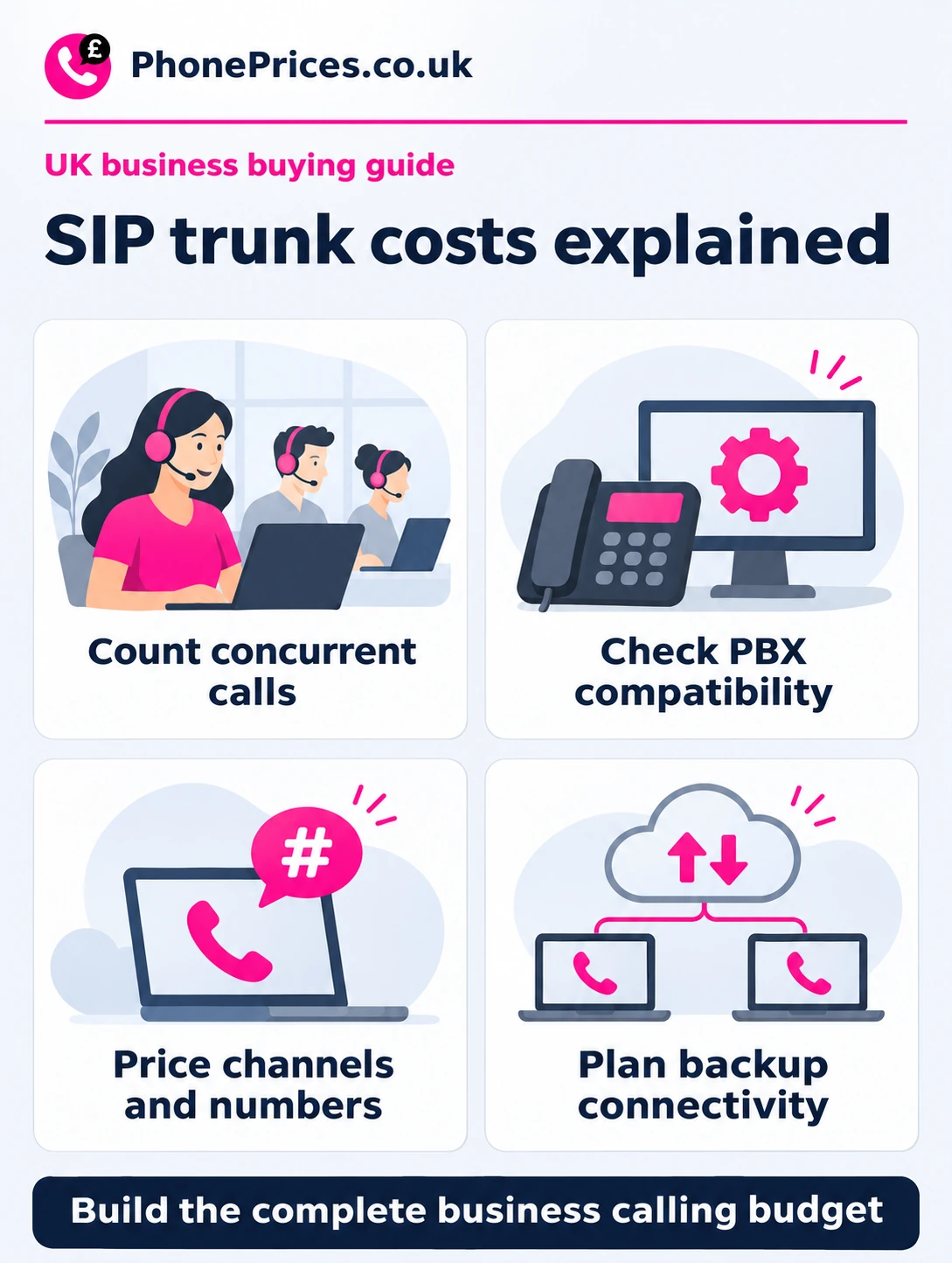
How many SIP channels should you buy?
Use the PBX’s peak simultaneous-call records if available. Average daily call volume is a poor substitute: 200 calls spread over a day can be easy to handle, while a short burst after a campaign can exhaust the same capacity. Include seasonal peaks and any deliberate growth in sales or support activity.
- Count inbound and outbound external calls at the busiest times, including queues and transfers as your provider defines them.
- Check whether channels are shared across sites or reserved for individual trunks.
- Ask whether temporary or permanent increases are possible and how quickly they take effect.
- Confirm the behaviour and cost when capacity is exhausted.
- Have the supplier document the relationship between its channel limit, your PBX licence and any session border controller capacity.
PAYG versus included SIP minutes
The difference between four PAYG channels at £16 and four SIP 1,000 channels at £40 is £24 a month ex VAT. Whether that premium is worthwhile depends on the charges it avoids. At an illustrative uniform 1p metered rate, £24 buys 2,400 minutes; at an illustrative 5p rate it buys 480 minutes. These are arithmetic examples, not the supplier’s call rates.
Use the actual destination tariff and billing increments. Separate standard UK landlines and eligible mobiles from international calls, premium numbers and excluded ranges. Check whether the 1,000-minute allowances can be pooled across channels and whether unused minutes expire; do not assume that an advertised total works in the way your PBX uses the trunk.
For a fuller explanation of this calculation, see our PAYG versus unlimited business calls guide. A bundle only saves money on the calls it actually includes.
Why other SIP price lists may not compare directly
sipgate’s dedicated trunking page publishes the package prices below, excluding VAT. Its inbound and outbound capacity figures are asymmetric, so a package is not directly equivalent to the same number of shared channels in another supplier’s tariff. Calls and any separately required numbers or PBX service must be added.
| sipgate package | Monthly package ex VAT | Monthly inc VAT | Published concurrent inbound / outbound calls | UK landline / mobile rates ex VAT |
|---|---|---|---|---|
| Starter | £4.95 | £5.94 | 1 / 100 | 1p / 9.9p per minute |
| Regular | £8.95 | £10.74 | 2 / 100 | 1p / 8.9p per minute |
| Plus | £19.95 | £23.94 | 5 / 100 | 1p / 8.9p per minute |
| Enterprise 10 | £39.95 | £47.94 | 10 / 100 | 1p / 7.9p per minute |
Confirm the actual supported capacity and current package availability for your PBX. The outbound capacity figure is not an included-minute allowance. Separately, Gradwell’s page title advertises trunks from £4 per month, while its main page asks buyers to request a quote. Treat that as an unqualified starting reference until Gradwell confirms the charging unit, tax, channel minimum and term.
An accurate comparison sheet should therefore contain a quote for the same capacity, PBX, numbers and call records from every candidate. Where a supplier does not publish all those details, a bespoke quote is more honest than calculating a precise-looking total from an incomplete headline.
The full SIP trunk budget
| Cost component | What to obtain | Why it matters |
|---|---|---|
| Channel rental | Quantity, minimum and contract term | Determines fixed external-call capacity cost |
| Calls | Destination rates, allowances and billing increments | Can outweigh the rental |
| Numbers | Included quantity, extra rental and number types | A block of direct dials may have a different charge |
| PBX | Licence, hosting and support | A trunk does not provide the complete phone system |
| Installation | Configuration, testing, migration and documentation | Retaining hardware does not eliminate engineering work |
| Connectivity | Broadband, router, firewall and backup | The service depends on working IP connectivity |
| Resilience | Failover destinations and diverted-call rates | A working diversion may still create usage charges |
For an illustrative budget, assume four SIP 1,000 channels at the published £40, plus separately quoted PBX hosting of £25 and support of £20. That totals £85 a month ex VAT before connectivity and excluded calls, or £2,040 over 24 months. If installation is assumed to be £200, the two-year total becomes £2,240. The £25, £20 and £200 figures are planning assumptions, not advertised tariffs.
A complete hosted system could be cheaper or dearer depending on user numbers and required features. Compare the same service outcome over the same term, including the remaining useful life and support cost of your current PBX.
Compatibility: what should the supplier confirm?
A system being SIP-capable is a starting point, rather than a guarantee that every trunk will work with it. Obtain support for the exact PBX version, authentication method, router/firewall arrangement, codecs and number presentation. Check that emergency calling and registered address details are configured for the deployment.
Test inbound calls to each important number, outbound calls, caller ID, transfers, voicemail, hold, queues and calls to mobiles. If you use a contact centre or a regulated recording workflow, include those in the acceptance criteria. Get configuration ownership and the support boundary documented so the PBX installer and carrier do not each assume the other is responsible.
Migration and backup
Keep the existing service active until the agreed port and migration process is complete. Our business number transfer guide covers planning around number records and port dates. Moving external lines also needs coordination with any old broadband or other service linked to them.
Separate a loss of the office broadband connection from a power cut, a PBX failure and a carrier outage. Mobile diversion may help with one problem but not every failure. Ask where the failover decision is made and whether it works when your on-site equipment is completely off.
The PSTN switch-off checklist is useful if SIP trunking forms part of a wider migration. Do not assume an alarm, lift telephone or payment device works simply because ordinary voice calls have moved successfully.
When SIP trunking is a sensible shortlist
It is worth considering when your current PBX remains supported, its features suit the business and you can obtain a clear compatibility and support agreement. A fully hosted system may be easier to budget for if you want to remove responsibility for the existing PBX or enable remote users without maintaining that infrastructure.
Ask each supplier for the complete two-year or three-year cost at your actual capacity and calling pattern. Select on the combined service, support and resilience requirements; a low channel price is one component of that decision.
Frequently asked questions
A SIP channel is capacity for one simultaneous external call under the provider’s service definition. It is different from a staff extension or public telephone number. Ask how queued calls, transfers and forwarded legs count, because these can affect the capacity your business actually needs.
One published UK example is IT Communications at £4 per channel per month excluding VAT, with a four-channel minimum and a 24-month term. That means £16 minimum rental before calls. Included-minute packages cost more, and PBX licensing, hosting, support, installation and broadband may be separate.
Not necessarily. Size the trunk around peak simultaneous external calls rather than headcount alone. An office with occasional callers can need fewer channels than users, while a telephone sales team may need more capacity. Use call records and include queues, transfers and peak periods in the assessment.
Some packages include a quantity of standard numbers, while others charge number rental separately. IT Communications advertises 10 standard UK numbers in the packages shown here. Confirm the number types, direct-dial blocks, extra rental and capacity separately; having several numbers does not automatically provide several simultaneous calls.
Usually the trunk supplies external connectivity for a compatible PBX, rather than the entire PBX service. You may still need software licences, hosting, support and endpoints. Ask for an itemised quote so a channel rental is not mistaken for the complete cost of running the telephone system.
Teams external calling requires a supported connectivity arrangement. A generic SIP trunk is not automatically a Teams Direct Routing service. Ask for the exact Teams licensing, certified infrastructure, carrier service and support scope, then compare that complete solution with Calling Plans or Operator Connect.
On-site SIP equipment may lose connectivity, so resilience must be designed in advance. Options include a separate backup connection or carrier-side diversion to another destination. Confirm what triggers failover, whether it works with the PBX powered off and what diverted calls cost.
Check the fair-use and permitted-use conditions. The IT Communications package shown here has a 3,000-minute fair-use limit per channel and excludes call centres, telemarketers and resellers. Other suppliers set different rules. Match the exact terms to your business activity and busiest expected usage.