
You can usually keep an existing UK business phone number when changing telephone provider or moving to VoIP. The transfer is called number porting. The new provider needs to check the number, the current service and the proposed destination before confirming the move.
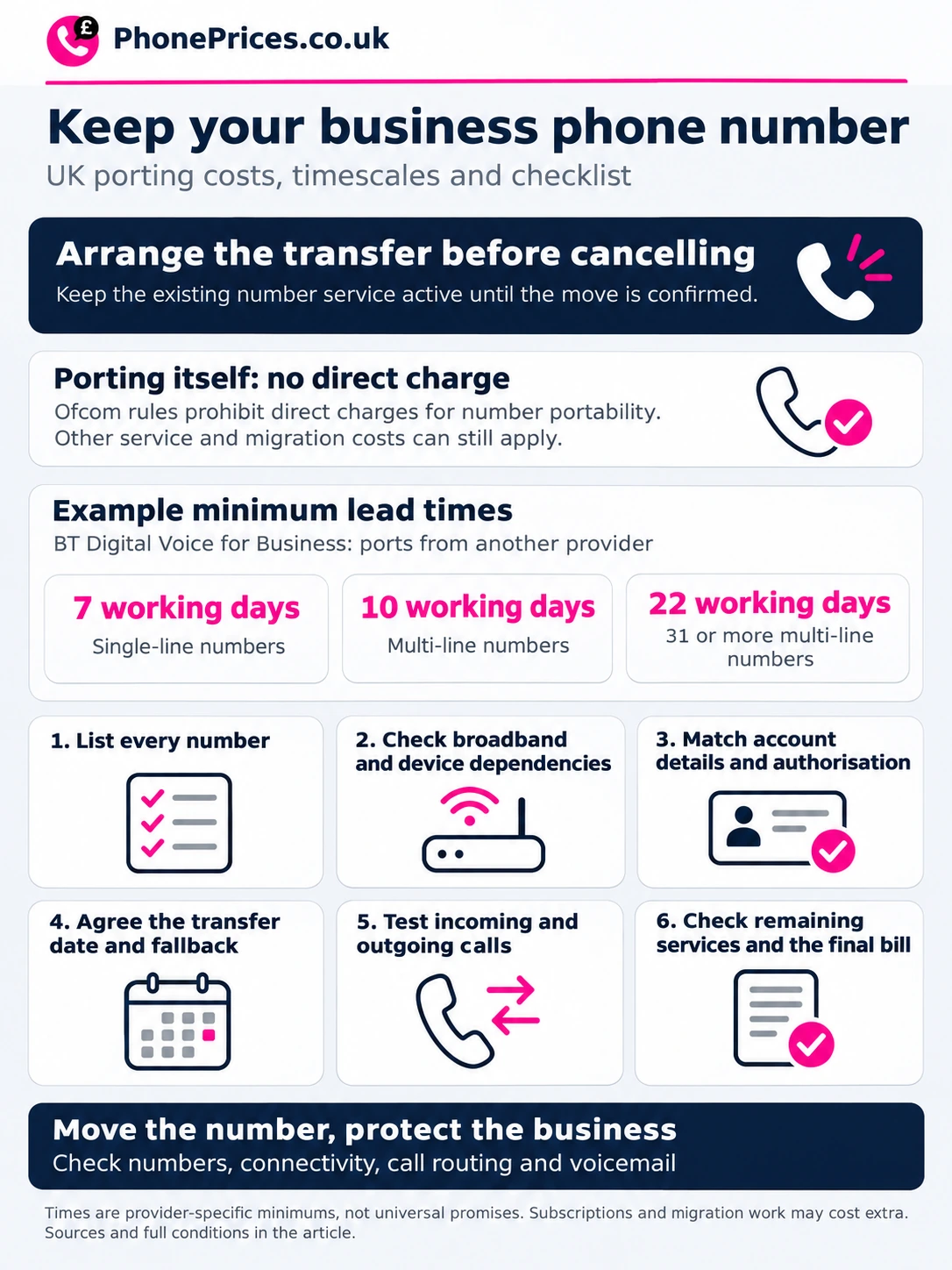
Arrange the transfer before cancelling the existing number service. A well-planned switch also protects broadband, alarms, direct-dial ranges and the way customer calls are answered. Moving the advertised number is only one part of replacing a business telephone service.
Keeping your business number: the main points
| Question | Practical answer |
|---|---|
| Can I keep the advertised number? | Usually, but ask the receiving provider to confirm eligibility for that number and service. |
| Who starts the port? | The receiving provider normally leads the transfer after you authorise it. |
| Should I cancel the old line first? | No. Coordinate the move before ending the existing number service. |
| Is porting itself chargeable? | Ofcom’s rules prohibit direct charges for number portability. Other service and migration costs are separate. |
| How long should I allow? | Obtain the provider’s actual lead time. Published examples range from days to several working weeks. |
| Will all services move automatically? | No. Inventory numbers, devices, routing and linked services individually. |
Guidance and provider examples checked on 25 November 2026. Ofcom explains keeping a number when switching. Its business-customer guidance describes the relevant switching protections. Eligibility and the practical cutover still need confirmation from your receiving provider.
Which business numbers can be transferred?
List the complete numbers you want to keep rather than sending only the number printed on your website. A system may have a main billing number, direct-dial numbers, fax numbers and ranges that are administered together. Ask the current provider for a number inventory if your records are incomplete.
| Number or service | What to confirm |
|---|---|
| 01 and 02 geographic numbers | Receiving-provider coverage, account details and any location-related requirements. |
| 03 national numbers | Support for the exact range and the service to which it will be moved. |
| 0800 and 0808 numbers | Inbound charging, routing and whether the receiving provider supports the number. |
| DDI ranges | The complete range, main number, associated numbers and whether the range can be split. |
| Existing VoIP numbers | The current service provider and underlying number arrangements, rather than assuming an app login identifies the carrier. |
| Mobile numbers | A separate mobile porting process and whether the destination service supports them. |
| Numbers already disconnected | Immediate recovery investigation; do not assume the number has been permanently lost or can definitely be recovered. |
DDI means direct dial-in: numbers that let customers reach individual staff or departments without going through the main reception number. A number range may contain unused numbers that are still part of the account. Confirm what happens to them before authorising a partial move.
Eligibility differs by product. For example, BT’s Digital Voice for Business porting guidance lists restrictions affecting some source products and lines supporting broadband or non-IP equipment. That is a limitation of the particular migration route, not proof that every provider must reject the same number.
Porting, forwarding and changing caller ID are different
| Action | What it does | What it does not establish |
|---|---|---|
| Port the number | Moves the number to the receiving service. | That every old contract, device and setting has been migrated. |
| Forward calls | Sends incoming calls onward to another destination. | That the number is held by a new provider or the old service can be cancelled. |
| Present business caller ID | Displays an approved business number on outgoing calls. | That incoming calls to that number arrive on the new system. |
| Create a temporary number | Allows testing or initial use of the receiving service. | That the existing advertised number has moved. |
A business can appear to be working after a new system is installed while the old provider still receives and forwards its incoming calls. Test the actual ported number and obtain completion confirmation before assuming that arrangement has ended. Our virtual landline guide explains forwarding and app-based calling in more detail.
How long does business number porting take?
Lead times depend on the receiving service, number type, quantity, accurate paperwork and the current provider’s response. Use the accepted transfer date for planning. A general statement about a one-day switch is not a promise that a new business port order can be submitted and completed within 24 hours.
| Published example | Indicative lead time | Important qualification |
|---|---|---|
| Voipfone – most single-number ports | 7–14 days | Its business porting page says more complex lines or larger quantities can take longer. |
| BT Digital Voice for Business – external single-line port | At least 7 working days | Number arriving from another provider. |
| BT Digital Voice for Business – external multi-line port | At least 10 working days | For multi-line numbers such as DDI ranges. |
| BT Digital Voice for Business – 31+ external multi-line numbers | At least 22 working days | Larger migrations need substantially more time. |
Sources: Voipfone business porting and BT’s product-specific lead times. These are provider examples, not a universal market timescale. Working days exclude weekends and relevant holidays; Voipfone’s quoted 7–14 days is reproduced without converting it into working days.
Request the expected transfer window, the last date for changing it and an escalation contact. Where several sites or number ranges are involved, agree a sequence rather than assuming everything can move safely at once.
What does number porting cost?
The port itself and the cost of changing service are different. Ofcom’s current General Conditions include C7.6(c), which prohibits direct charges to the switching customer for number portability. This is also stated in its business guidance. Check that rule before accepting a charge described as a porting or port-out fee.
You may still need to budget for the new service, configuration, equipment, connectivity and any valid remaining contractual commitment. Require an itemised explanation of what each charge purchases. A provider should not simply rename the act of porting as an unexplained administration charge.
| Published provider example | Price reference | What the figure means |
|---|---|---|
| Voipfone – incoming port | £0 | Its business page advertises moving a number without a transfer charge; ongoing service is additional. |
| CircleLoop – incoming port | £0 | Its pricing page advertises free number porting; confirm number eligibility. |
| Voipfone 100 | £5/user/month ex VAT; £6 inc VAT | An example ongoing subscription, not a porting fee. |
| Voipfone 500 | £10/user/month ex VAT; £12 inc VAT | A larger calling allowance; optional services remain separate. |
| CircleLoop PAYG | £5/user/month ex VAT; £6 inc VAT | An ongoing licence with outgoing calls charged from the published starting rate. |
Price sources: Voipfone porting, Voipfone plans and CircleLoop pricing. VAT-inclusive subscription amounts are calculated at 20%. Confirm the exact plan, allowances and order total.
What if a provider publishes a port-out fee?
Some published tariffs and terms conflict with the no-direct-charge position. VoIPstudio’s terms list £15 for an individual number, £8 per number in a 10-number range and £3 per number in a 100-number range. These are published charges to question, not fees this guide endorses as payable.
Ask the provider to explain how a proposed charge is consistent with Ofcom’s current General Conditions. Request the answer in writing and use the provider’s complaints process if the point remains unresolved. Keep the disputed number-porting charge separate from any valid bill for other products.
Worked example: the cost of changing service
Suppose one user moves to the £10 ex VAT/month Voipfone 500 subscription. Assume, purely for budgeting, a £25 final old-service bill and £60 of separately agreed configuration work. Existing devices are retained, and no direct number-porting charge is included.
| Budget item | Ex-VAT amount | Basis |
|---|---|---|
| New first-month subscription | £10 | Published one-user tariff example. |
| Old service’s final bill | £25 | Assumed input; use the actual valid final charges. |
| Configuration work | £60 | Assumed separate service, not a porting charge. |
| New hardware | £0 | Assumes existing compatible devices or apps. |
| First-month total | £95 | £114 including VAT if all items attract 20% VAT. |
| First-year total | £205 | 12 × £10 + £25 + £60; £246 including 20% VAT. |
This is a labelled calculation, not a supplier migration package or a market average. Extra users, equipment, calling outside allowances and a different final bill change the result. The purpose is to separate recurring cost from one-off work and the number transfer itself.
Information to collect before submitting the request
- Every number: the main number, each DDI, the full ranges and the numbers you want to retain or release.
- The correct account identity: the business name and account-holder details recorded by the current provider.
- Service details: account reference, billing number and the address or postcode associated with the line.
- Evidence: a recent bill or other documentation the receiving provider accepts.
- Authorisation: a person entitled to approve the move and a signed Letter of Authority if requested.
- Dependencies: broadband, alarms, lift phones, payment terminals, fax and other services linked to the number or line.
- The destination configuration: which staff, queues, voicemail boxes or branches should receive each number.
- Working contacts: someone available before, during and after cutover.
Voipfone’s business porting guidance, for example, asks for a telephone bill showing the name, address and number and warns that inaccurate forms can cause rejection. Use the provider’s exact requested details; a trading name on your website may differ from the account name on the old service.
Check broadband and specialist devices before porting
A number can be part of the arrangement that supports an existing broadband service. Moving it can trigger changes or cessation that affect connectivity. Ask both providers to describe the result in writing and establish the replacement connection before relying on the new phone system.
Walk the premises and record what is connected to each telephone socket, cabinet and line. An alarm or lift communicator can matter more than the office handsets. Have the equipment supplier confirm the migration method and testing; do not assume an ordinary VoIP adapter proves compatibility.
If a building is shared, identify which numbers and devices belong to your business, the landlord or another tenant. Request permission and the relevant supplier contact before changing services you do not administer. Our PSTN switch-off checklist covers the wider equipment audit.
Why are number-port requests delayed or rejected?
| Possible problem | What to investigate |
|---|---|
| Name or postcode mismatch | Compare the request with the current provider’s service records, not just the latest business letterhead. |
| Wrong provider identified | Establish the service provider and any reseller arrangements. |
| Incomplete DDI range | Ask whether associated numbers or the full range have to be handled together. |
| Unclear authority | Provide the requested authorisation and account-holder evidence. |
| Pending orders | Check for changes, cancellations or other transfer requests already in progress. |
| Disconnected service | Ask immediately whether the number can still be recovered and transferred. |
| Unsupported destination product | Ask for a supported migration route rather than repeatedly resubmitting unchanged information. |
Request the specific rejection reason and the field that needs correcting. Repeatedly submitting the same incomplete information rarely helps. Keep a single named owner within the business so that different staff do not authorise conflicting orders.
Planning for calls during the transfer
Allow for an interruption and agree a fallback plan. Confirm whether a provider-level divert can operate during the actual cutover; a forwarding rule in a disconnected old system may not help. Keep an independently reachable contact route for staff and important customers.
- Pick a transfer window that avoids the busiest customer period where the supplier offers that choice.
- Have the current and receiving provider’s support details available outside the phone system being changed.
- Give reception and customer-service staff the temporary response plan.
- Keep access to the website and business listings so an alternative contact can be displayed if needed.
- Record the start time of any interruption and report unresolved faults promptly.
- Avoid promising uninterrupted service to customers unless the suppliers have agreed and tested the arrangement.
Tests to run before accepting completion
| Test | What to verify |
|---|---|
| Incoming calls | The advertised number reaches the intended destination from more than one external network where practical. |
| Outgoing calls | The right business caller ID appears and callbacks reach the new service. |
| Busy and simultaneous calls | Queues, waiting, overflow and voicemail behave as intended. |
| Business hours | Open, closed and holiday routes use the correct messages and destinations. |
| DDIs | A representative test of each migrated number, with critical numbers checked individually. |
| Devices and locations | Desk phones, mobile apps, remote users and branches work on their actual connections. |
| Account and records | Numbers appear in the receiving account and required call data has been retained. |
| Emergency arrangements | Registered location information and the independent fallback have been confirmed with the provider. |
Save confirmation that the number has moved, then review the old account for remaining products. Check what the transfer itself has terminated before ordering further cancellations. Other numbers, equipment, support and connectivity may have separate arrangements. Our no long-term contract VoIP guide explains cancellation and equipment commitments.
If the number has already been cancelled
Contact the receiving provider and the former provider immediately. Ofcom’s number guidance says a transfer can usually still be requested for up to one month after the previous service ends. That is a recovery protection to investigate, not a reason to cancel first or a guarantee in every situation.
Provide the complete number, the date service ended and proof of the account. Ask the provider to preserve and recover it while the request is investigated. Keep a record of each response and use another contact route for customers until the outcome is clear.
How this guide was researched
We checked Ofcom guidance, the current General Conditions and provider-owned porting, pricing and support pages on 25 November 2026. Provider lead times are presented as named examples, and ongoing subscriptions are separated from the transfer itself. Hypothetical budget inputs are labelled.
No comparison website is used as a price source. This guide does not claim that every number is accepted by every product, or that the service will be uninterrupted. Obtain a written migration plan for the actual account, numbers and dependencies involved.
Frequently asked questions
Usually, subject to the receiving provider confirming that the number and source service can be transferred. Give it the complete number, account details and any associated ranges. Test the destination service first and keep the existing number service active until the port is confirmed as complete.
Arrange the port before cancelling the service carrying the number. Ending it too early can complicate the transfer and interrupt calls or linked services. Ask the receiving provider how the move affects the old account, then check remaining products and valid charges once completion has been confirmed.
The lead time depends on the number, provider, quantity and paperwork. Published examples include days or several working weeks. Request a confirmed transfer date rather than treating a general one-working-day switching rule as the entire ordering timescale. Build time into the plan for validation and correction of errors.
Ofcom’s business guidance says customers must not be directly charged for number porting. Other service, equipment and migration-work costs are separate. If a provider proposes a port-out or administration charge for the transfer itself, ask it to explain the charge against the current rules before accepting it.
It can affect broadband where the number and connection depend on the same old line arrangement. Ask both providers what will happen and arrange a supported migration route. Do not assume that a new phone subscription also replaces connectivity or that the existing broadband will continue unchanged.
Ask the receiving provider to check the full range and associated main numbers. Confirm whether the range must move together, which numbers are active and how each will route afterwards. Larger or more complex migrations can require longer lead times and more extensive validation than a single-number port.
A PAC belongs to the mobile switching process. Business landline and VoIP-number transfers normally use the receiving provider’s porting request and authorisation procedures instead. Identify the number type before following instructions, and check that the destination service supports that exact type of transfer.
A break can occur during cutover, so agree the expected window and fallback arrangements in advance. Confirm which diversions will still work at that stage. Keep an independent contact route and test incoming calls, outgoing caller ID and routing as soon as the provider reports completion.
Contact both providers immediately and ask about recovery and porting. Ofcom says a transfer can usually still be requested for up to one month after the old service ends. Provide proof of the account and the disconnection date, but do not assume recovery will be possible in every case.
Do not assume so. Porting moves the number; menus, greetings, hours, voicemail, recordings and integrations may need separate configuration or export. Document the old call flows, recreate the required setup and test it on the new system before treating the migration as fully complete.