
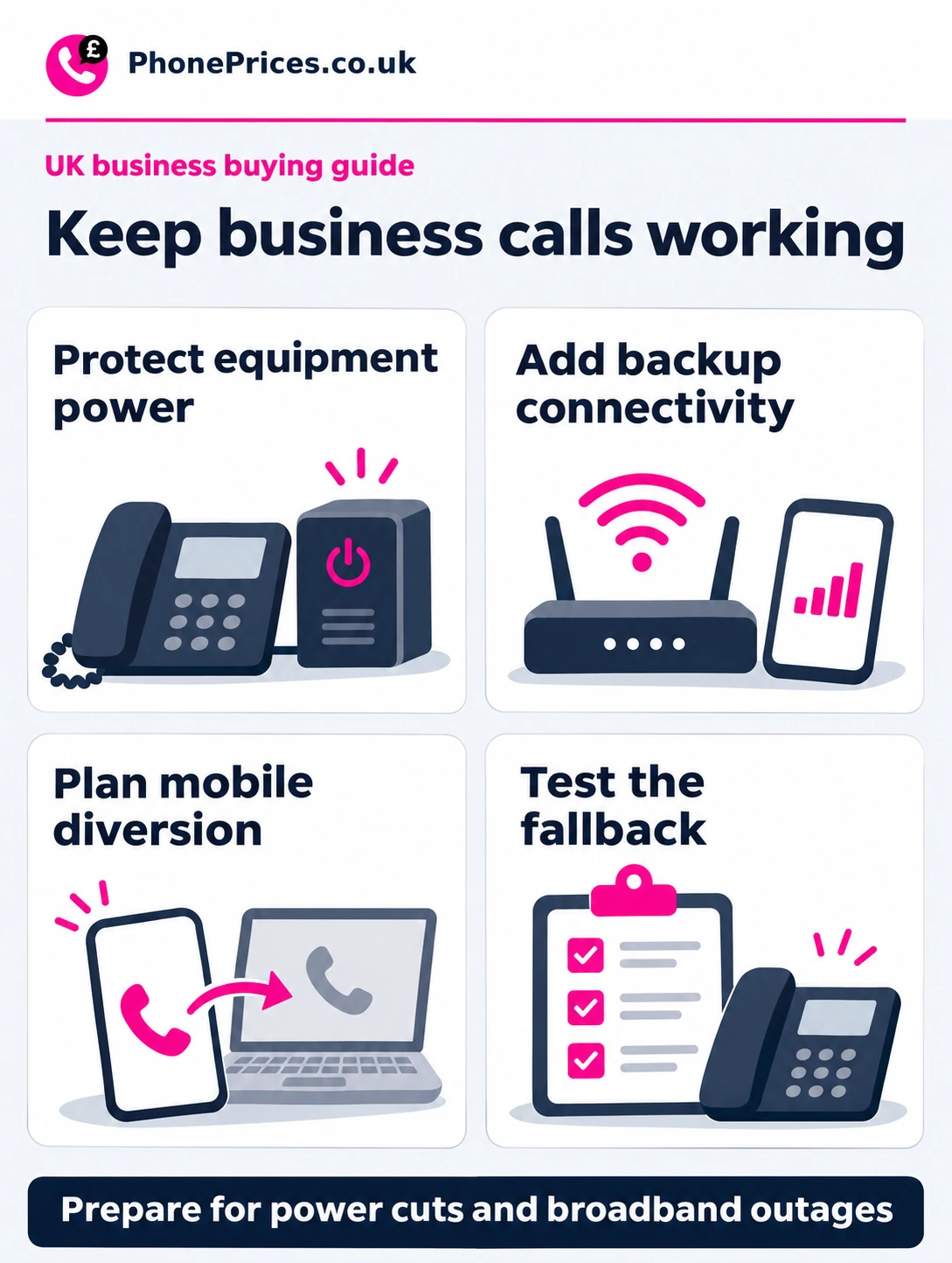
A business VoIP phone needs more than a charged handset. The router, fibre termination equipment, network switches, phone base and internet connection may all need to work before a call can reach the desk. A battery for one device cannot fix every point of failure.
The practical solution is usually a combination of backup power, an alternative internet route and a way to answer calls away from the premises. Costs range from a small compatible DC battery unit to a managed design for several sites. This guide explains what each option covers, gives a specific equipment price example and shows how to build a complete budget.
What stops working in different outages?
The government’s digital landline guidance explains the migration to internet-based calling and the need to consider resilience. For a business, assess the complete path from the public phone service to the person answering, rather than treating a powered router as proof that calls will work.
| Failure | What may help | What it does not necessarily solve |
|---|---|---|
| Power cut at the premises | Correctly sized UPS or compatible battery backup | A failed access network, broadband line or carrier service |
| Fixed broadband fault | Tested 4G/5G backup or independent second connection | Loss of power to the router or poor mobile coverage |
| On-site PBX or network failure | Carrier-side diversion or a supported off-site answering route | A carrier outage affecting the original number |
| Hosted platform outage | Provider continuity arrangements and an independent contact route | A local battery does not repair the platform |
| Staff cannot access the building | Mobile apps or preconfigured remote answering | Uncharged mobiles, unavailable data or missing account access |
What does backup power cost?
As a specific price reference checked on 25 November 2026, Ballicom listed Eaton’s 3SM36B at £44.29 excluding VAT (£53.15 including VAT), with delivery extra and the item marked out of stock. This is a displayed equipment reference, not an immediately available installation quote.
Eaton identifies that model as a 36W Mini UPS with a BS input and selectable DC outputs at 9, 12, 15 or 19V, using compatible barrel adaptors. It is not a general UK mains socket for powering an entire phone system. Match voltage, polarity, connector, current and supported load to the device before buying.
| Option | Price basis | Main buying check |
|---|---|---|
| Eaton 3SM36B Mini UPS | Displayed £44.29 ex VAT; £53.15 inc VAT; out of stock at checked retailer | Suitable DC device and connector; obtain runtime at your load |
| AC UPS for several devices | Obtain an itemised equipment quote | Total watts, outlet types, runtime and battery maintenance |
| 4G/5G backup router | Hardware plus a suitable SIM/data tariff | Coverage, failover behaviour and voice-platform compatibility |
| Mobile diversion | Phone plan plus any diverted-call charges | Carrier-side trigger, destination and per-minute cost |
| Managed resilient service | Quoted setup and recurring charges | Scope, support responsibility, test results and failure coverage |
Avoid comparing a small DC unit with a larger AC UPS purely on price. A fibre ONT, router, PoE switch and DECT base may need several different supplies. An installer should list each device and show which are covered. A cordless handset battery does not power its base station.
How long will a UPS keep calls working?
Use the manufacturer’s runtime curve for the selected model at your measured load. A maximum watt rating tells you what the unit can supply, not how many hours it will last. Battery age, temperature, conversion losses and the equipment’s changing demand affect the result.
For arithmetic only, imagine a usable energy budget of 40Wh, an 80% delivery factor and a constant 20W load. The estimate is 40 × 0.8 ÷ 20 = 1.6 hours. Those are hypothetical figures and do not describe the Eaton product above. They illustrate why a low-power router and a large network switch can have very different runtimes.
Decide the minimum useful runtime for your business, then obtain and test a design against it. Protecting just the essential network and one answering device can be more practical than trying to keep every workstation running. Include battery inspection and replacement in the maintenance budget.
4G and 5G backup: check more than signal bars
A backup mobile connection must carry the voice service correctly as well as reach the internet. Test actual inbound and outbound calls after failover, including calls already in progress. Some transitions will interrupt an active conversation even where new calls work afterwards.
- Check indoor coverage where the router and antenna will be installed, at busy times as well as quiet ones.
- Use a SIM and tariff suitable for the router, intended traffic and business use.
- Confirm the phone provider supports the backup network arrangement, including addressing and registration behaviour.
- Test automatic failover and the return to the main connection; record how long new calls take to recover.
- Establish data allowances, expiry, top-ups and what happens if the backup is used for an extended period.
- Power the backup router and any essential network equipment during the same power-cut scenario.
A second connection is most useful when it avoids the failure affecting the first. Two services that share a vulnerable local route or depend on the same unprotected equipment may offer less independence than the marketing description suggests. Ask the supplier to explain what is physically and operationally separate.
Mobile apps and carrier-side diversion
If the hosted platform remains available, staff may be able to answer through its app using mobile data elsewhere. Alternatively, carrier-side rules can divert the main number to an ordinary mobile. Confirm where the rule runs: a diversion stored only in a failed on-site PBX may not operate when that PBX is off.
Diversion can create usage charges. Voipfone’s tariff, for example, lists standard major-network mobile calls at 7p per minute ex VAT and states that diverted calls use the dialled-call rate; other ranges can cost more. At that 7p rate, 100 diverted minutes are £7, 300 are £21 and 1,000 are £70 before VAT, unless covered by the applicable package.
Have staff test the caller ID, ability to transfer, voicemail fallback and outbound business-number presentation on the alternative route. Receiving the main number on a mobile does not automatically make a normal mobile callback display that main number.
A worked first-year backup budget
The following is a planning example, not a supplier package or typical-market quotation. Assume a suitable AC UPS costs £150 ex VAT, a backup router costs £100, a suitable data plan costs £10 a month and installation/testing costs £120.
| Assumed component | First-year cost ex VAT | Recurring basis |
|---|---|---|
| Suitable AC UPS | £150 | One-off; future battery maintenance extra |
| Backup router | £100 | One-off |
| Data plan | £120 | £10/month |
| Installation and documented testing | £120 | One-off in this example |
| First-year total | £490 | Before phone licences, diverted calls and future maintenance |
At unchanged pricing, the data subscription alone would be £120 in the following year. If an incident also generated 300 mobile-diverted minutes at the published 7p example rate, add £21 ex VAT. Add any other call, support or equipment costs that the chosen design actually requires.
Set that budget against your own operational exposure. If a missed trading hour has an estimated £100 contribution impact, the £490 example equates to 4.9 such hours. That is a planning comparison, not a prediction that the equipment will prevent those losses or eliminate every outage.
Test a real fallback before you need it
- Write down the normal call path and the devices that need power.
- Agree a quiet testing window and tell the affected staff.
- Simulate loss of the main internet route using the installer’s safe procedure.
- Check inbound calls, outbound calls, caller ID, voicemail and emergency-calling configuration.
- Test the agreed power-loss scenario and record the supported load and observed runtime.
- Verify diversion works without relying on equipment that is switched off.
- Restore the normal arrangement and confirm routing returns correctly.
- Keep a short staff procedure and retest after material equipment, network or provider changes.
Emergency calling and other connected equipment
Ask the provider how emergency calls and location information work on normal and backup routes, especially for mobile or remote users. Agree a practical independent way for staff to contact emergency services if the business phone route is unavailable. Do not assume every business receives a free battery unit or the same resilience arrangement.
An alarm, lift phone, telecare device or other specialist connection needs its own supplier-approved migration and resilience assessment. A successful ordinary voice test does not prove those devices work. See our business PSTN switch-off checklist for the wider inventory.
Frequently asked questions
Only if the necessary equipment and network path remain operational. A charged handset alone may not help when its base, router, fibre termination or switch has lost power. Identify the complete call path and test a suitable backup-power and alternative-answering arrangement for your actual installation.
A UPS supplies backup power to compatible equipment; it does not repair a failed broadband line or carrier network. A separate connection or carrier-side diversion may address those failures. Design and test the options together so each covers a clearly identified part of the call path.
One checked reference is Eaton’s 3SM36B Mini UPS, displayed by Ballicom at £44.29 excluding VAT, or £53.15 including VAT, with delivery extra and no stock at the time. It is a DC device-specific option, so compatibility and runtime must be confirmed rather than assumed.
Runtime depends on the selected unit, connected load, battery condition and environment. Use the manufacturer’s runtime information at your measured load, then test the installation. A watt rating describes capacity to supply power, not a guaranteed duration, and a handset battery does not power the whole system.
Many services offer diversion or failover, but confirm that the rule runs on equipment or a platform that remains available during the intended failure. Test the trigger, caller experience, voicemail and charges. A rule stored only in an offline on-site PBX may not provide the fallback you expect.
Not necessarily. They may create an outbound call to the destination mobile and consume an allowance or incur a per-minute charge. Price the actual number range and expected duration. Voipfone’s published 7p major-network mobile example would cost £21 excluding VAT for 300 minutes outside applicable inclusions.
It can help with a fixed-line fault, but needs suitable coverage, data, power and compatibility with the phone service. Test real calls during failover and after restoration. Consider shared infrastructure and local congestion, and do not assume active calls will continue without interruption.
Set a documented schedule appropriate to the business and retest after material changes to routers, equipment, phone providers or call routing. Record inbound and outbound results, recovery time and runtime. Staff should know the fallback procedure and where to report a failure discovered during the test.