
Microsoft Teams can make and receive ordinary telephone calls, but a Teams meeting licence alone does not necessarily provide a business phone number and external calling. You need the right Teams entitlement, phone-system functionality and a connection to the public telephone network.
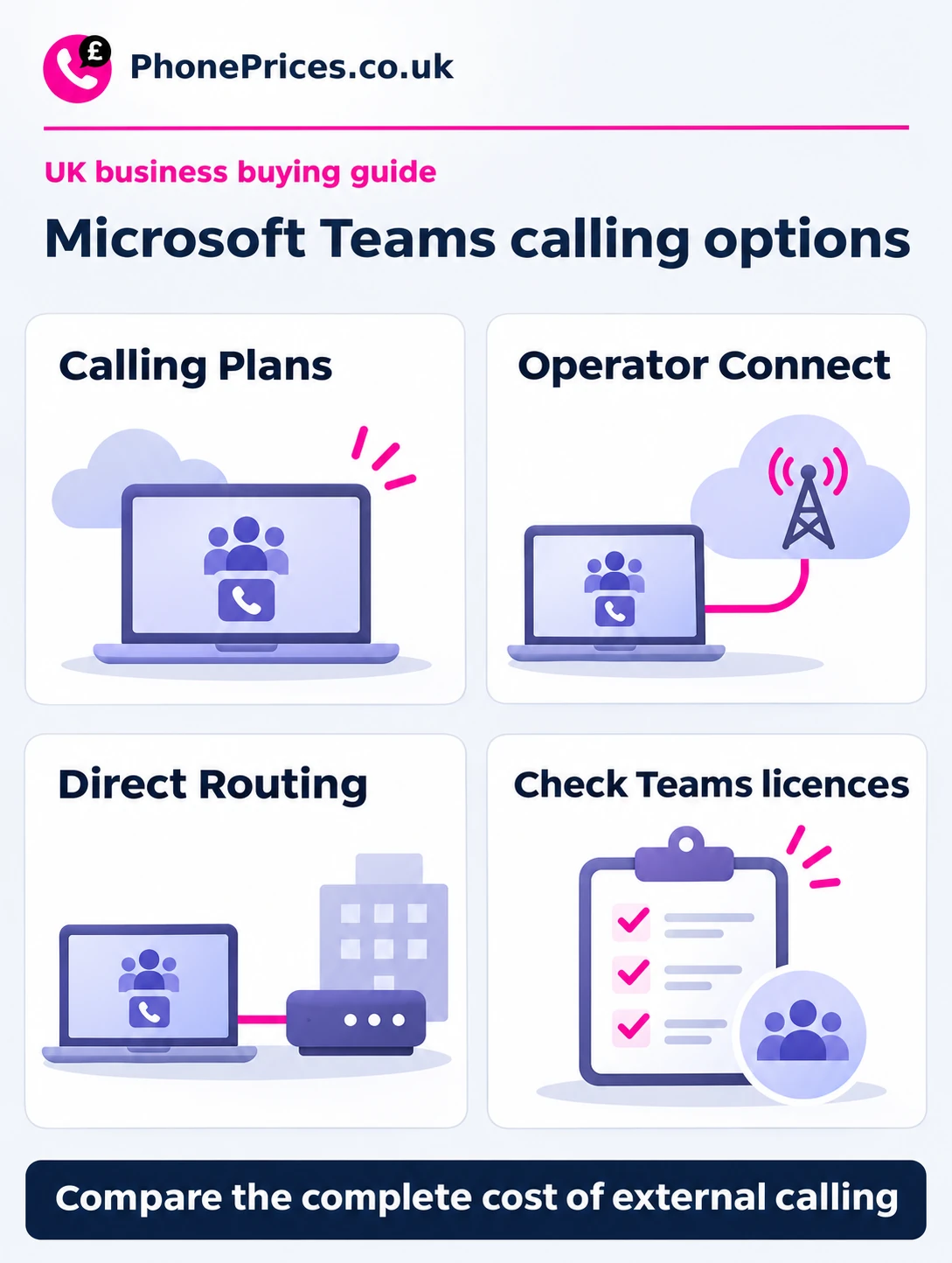
The main buying routes are Microsoft Calling Plans, Operator Connect and Direct Routing. Their costs are structured differently: Microsoft can supply the calling package itself, or a carrier can supply connectivity alongside Teams Phone. This guide separates those layers and shows the UK published licence prices and comparable budgeting calculations.
Teams Phone prices in the UK
Prices checked on 25 November 2026 on Microsoft’s UK Teams Phone page. These are per-user monthly equivalents, paid yearly on an annual subscription, excluding VAT. A qualifying Teams licence is separate where indicated by Microsoft. Do not add Phone Standard again to a bundle that already includes it.
| Microsoft product | Per user/month, paid yearly | Annual cost per user | What the price covers |
|---|---|---|---|
| Teams Phone Standard | £7.70 | £92.40 | Phone-system functionality; external connectivity purchased separately |
| Teams Phone with PAYG calling, country zone 1 | £9.20 | £110.40 | Phone functionality and PAYG connectivity; usage charges extra |
| Teams Phone with domestic calling, UK | £13.10 | £157.20 | Phone functionality and 3,000 eligible UK domestic outbound minutes |
| Teams Phone with domestic and international calling | £26.10 | £313.20 | Phone functionality with 3,000 domestic or 600 international outbound minutes under the plan rules |
The domestic and international allowance is not a promise of 3,000 domestic minutes plus 600 international minutes. Check Microsoft’s allocation and destination rules for the users and countries on your order. At 20% VAT, £7.70 is £9.24, £9.20 is £11.04, £13.10 is £15.72 and £26.10 is £31.32.
Calling Plans, Operator Connect and Direct Routing compared
Microsoft’s connectivity documentation describes the supported models and how they can be combined. The right option depends on country coverage, carrier relationships, technical requirements and who will support the deployment.
| Route | Who supplies external connectivity? | What belongs in the budget? | Useful purchasing question |
|---|---|---|---|
| Microsoft Calling Plans | Microsoft | Eligible Teams licence, selected Phone/calling package, extra usage and implementation | Does the bundle cover our users, destinations and numbers? |
| Operator Connect | A participating certified operator | Eligible Teams licence, Phone entitlement, operator package and support | Who handles number migration and a failed inbound call? |
| Direct Routing | A carrier through a supported session border controller arrangement | Eligible Teams licence, Phone entitlement, carrier charges, SBC service and integration | Who owns and supports every part of the voice path? |
| Teams Phone Mobile | A participating mobile operator | Eligible Microsoft entitlements and the supported mobile operator offer | Can our required mobile numbers and devices use this service? |
An operator can offer a managed service in which much of the technical work is included. Direct Routing does not mean that your business must own physical equipment, but it does require a supported design and clear responsibility for the session border controller, or SBC, that links the services.
Calling Plans: the most direct published comparison
With Microsoft’s UK domestic package at £13.10, ten users cost £131 a month equivalent and £1,572 a year excluding VAT. Twenty users cost £262 and £3,144 respectively. These totals cover the named package, not any separate Teams entitlement, headsets, implementation or excluded calls.
| Users | Domestic package monthly equivalent | Domestic package annual commitment | Phone Standard only, monthly equivalent |
|---|---|---|---|
| 5 | £65.50 | £786 | £38.50 |
| 10 | £131 | £1,572 | £77 |
| 20 | £262 | £3,144 | £154 |
| 50 | £655 | £7,860 | £385 |
The Phone Standard column is not a complete calling alternative. Add external connectivity to it before comparing against the domestic bundle. Otherwise you are comparing a phone-system licence with a phone-system licence plus a telephone service.
Operator Connect: how to compare a carrier quote
Ask the operator to split its quote into Microsoft licences, calling service, numbers, installation and ongoing management. Some suppliers bundle those items; others expect you to bring your own Microsoft entitlements. Compare the account total after removing any duplicate licence.
For a purely illustrative calculation, assume ten users already have eligible Teams licences and need Phone Standard at £7.70 plus an operator package quoted at an assumed £4 per user. The total is £117 a month ex VAT before setup or other extras: ten × (£7.70 + £4). The £4 is a planning assumption, not a current operator offer.
Against Microsoft’s £131 domestic-package equivalent, that example has a £14 monthly difference, or £168 a year. A separate management fee of £20 a month would reverse the comparison. This is why a low carrier headline is insufficient without the full service scope and calling allowance.
Direct Routing: budget for the complete service
Direct Routing can suit businesses with specialist routing, international or integration requirements, but it is not automatically cheaper. Add the carrier service, the SBC arrangement, configuration and support. Establish whether the carrier bills by user, concurrent call, number, minute or a combination.
In an illustrative ten-user model, Phone Standard is £77 a month, an assumed carrier service is £30, and an assumed managed SBC/support charge is £25. The recurring total is £132 ex VAT. Add an assumed £300 implementation fee and the first year reaches £1,884, excluding separate Teams licences and any metered calls. Only the £7.70 Microsoft rate is a published price in that illustration.
The point is to make a quote reviewable, rather than suggest those assumed figures are typical market charges. Ask every supplier to price the same users, countries, numbers, peak call capacity and support requirements over the same contract period.
Check the Teams licence you already own
Start with an inventory of existing Microsoft subscriptions and assigned entitlements. Products sold with and without Teams, enterprise bundles and existing phone entitlements can make the incremental cost very different between two businesses. Have the licensing administrator confirm what each proposed user already has before ordering add-ons.
A receptionist, meeting-room device or shared-area telephone may have a different supported licensing requirement from a named employee. Ask for those endpoints to be listed explicitly. Avoid buying ordinary user licences for every device by assumption, or assuming one employee licence covers an entire shared environment.
What can sit outside the quoted monthly price?
- Qualifying Teams access. A Phone add-on can require a separate eligible Teams subscription.
- Calls outside the allowance. Obtain destinations, overage rates, premium-number rules and any spending controls.
- Numbers. Separate ordinary direct dials, service numbers, freephone usage and extra number rental.
- Implementation. Include call flows, auto attendants, queues, porting coordination, emergency locations and acceptance testing.
- Hardware. Confirm support for existing headsets and certified desk phones, rather than assuming any SIP phone connects directly.
- Advanced features. Specialist contact-centre, compliance-recording, analytics or AI products can need extra licences and implementation.
- Support. Specify who diagnoses a fault across Microsoft, the carrier, network and endpoint.
A practical selection process
- Define users, shared devices, sites, countries, main numbers and peak calls.
- Audit existing Microsoft entitlements and calculate incremental licences only.
- Export representative outbound calls and price the same mix under each route.
- Require an itemised quote with tax, annual commitment, renewal terms and change rules.
- Demonstrate reception, queues, mobile use and emergency-calling arrangements before migration.
- Agree number-transfer dates, testing, fallback routing and who owns each support task.
- Reconcile the first full invoice with the quote and remove any superseded service only after checking dependencies.
Which option should a UK business shortlist?
Calling Plans are a useful benchmark where Microsoft supplies the required calling coverage and the published allowance matches usage. Operator Connect deserves comparison where a participating operator offers suitable calling, migration and support. Direct Routing merits consideration where a supported design meets requirements the simpler routes do not address.
The relevant decision is the complete service you can operate and support. Compare it with a separate business VoIP system if Teams is not essential for calling. Our number transfer guide also helps plan the move without treating a port as an ordinary cancellation.
Frequently asked questions
Teams meetings and internal calling do not automatically provide public-network calling. Check whether your subscription includes the necessary phone entitlement and external connectivity. A complete arrangement may require a qualifying Teams licence plus a Microsoft calling bundle, or Teams Phone with an operator service.
Microsoft publishes £7.70 per user per month, paid yearly, excluding VAT on the checked UK page. That is £92.40 per user annually. It supplies phone-system functionality but does not by itself cover all external calling costs; eligible Teams access and public-network connectivity must also be accounted for.
The named Teams Phone bundles in this guide already include phone-system functionality, so do not add Phone Standard a second time. A qualifying Teams licence can still be separate. Ask the reseller to identify included entitlements and remove any duplicate line items before approving the order.
Operator Connect is a supported way to use a participating operator for public-network connectivity alongside Teams Phone. Compare the operator’s service, numbers, call allowances, contract and support with Microsoft’s own calling package. The carrier quote may or may not include your Microsoft licences, so request an itemised total.
Direct Routing can involve carrier charges, a supported session border controller arrangement, implementation and ongoing support alongside Microsoft licences. A managed provider may bundle these items. Compare the whole design at your actual user count and call capacity rather than treating a carrier minute rate as the complete price.
Do not add the headline domestic and international allowances together. Microsoft describes the package as 3,000 domestic or 600 international minutes under its plan rules. Confirm the treatment of mixed calling, eligible countries and excess usage for the exact subscriptions on your order.
Number retention depends on eligibility, the chosen operator or Microsoft service and the transfer process. Confirm every main number and direct-dial block before ordering. Keep the current service active until the migration plan says otherwise, and test inbound calls and outbound number presentation after transfer.
No. The answer depends on Microsoft entitlements, carrier pricing, SBC costs, implementation, support and actual calls. A low connectivity charge can be offset by management or setup fees. Compare complete costs over the same period and include the work needed to keep the service supported.