
Dialpad and Nextiva need to be compared at product and licence level. For a UK business, the useful test is whether each proposal supplies the right numbers, outbound calling, call handling and support at an acceptable total cost.
Dialpad is worth considering for teams that value call transcripts, summaries and integration-led workflows; Nextiva is relevant to organisations evaluating customer conversations, automation and a potential international deployment. These are editorial suitability judgements based on current provider information, not a measured ranking or a claim that either is best for every organisation.
Dialpad vs Nextiva: the important differences
| Factor | Dialpad | Nextiva |
|---|---|---|
| Product position | Dialpad Connect is a hosted business calling platform with transcription and other AI-assisted calling tools. Its global price selector can show dollars even on pages visited from the UK, so region and billing frequency matter. | Nextiva’s current public pricing describes Go, Business and CX packages in US dollars. These are reference prices for that advertised offer, rather than verified sterling tariffs for a UK business telephone line. |
| Good reason to shortlist | Teams that value call transcripts, summaries and integration-led workflows | Organisations evaluating customer conversations, automation and a potential international deployment |
| Entry public arrangement | Standard: From £12 | Go: US$10 |
| Key condition | The UK virtual-number page quotes Standard from £12 and Pro from £20, while the main pricing page may display US dollar rates. Confirm the current UK checkout price, minimum seats, billing term and required integrations. | A UK buyer must obtain written confirmation of UK number supply, number porting, emergency calling, local support and contract eligibility. Do not convert a dollar headline into an advertised UK price. |
| Features to investigate | Connect provides calling across supported devices with transcription and summaries. Pro adds more integrations and support options, and Enterprise is quoted. Contact-centre products are a separate purchasing decision. | The current range combines voice and other conversation channels. Business adds more connections and workflow tools; CX adds advanced queues and supervisor functions. Exact telephony coverage and usage are contract-specific. |
Prices on a comparable basis
| Product / plan | Specific price | Charging unit | Conditions | Price source |
|---|---|---|---|---|
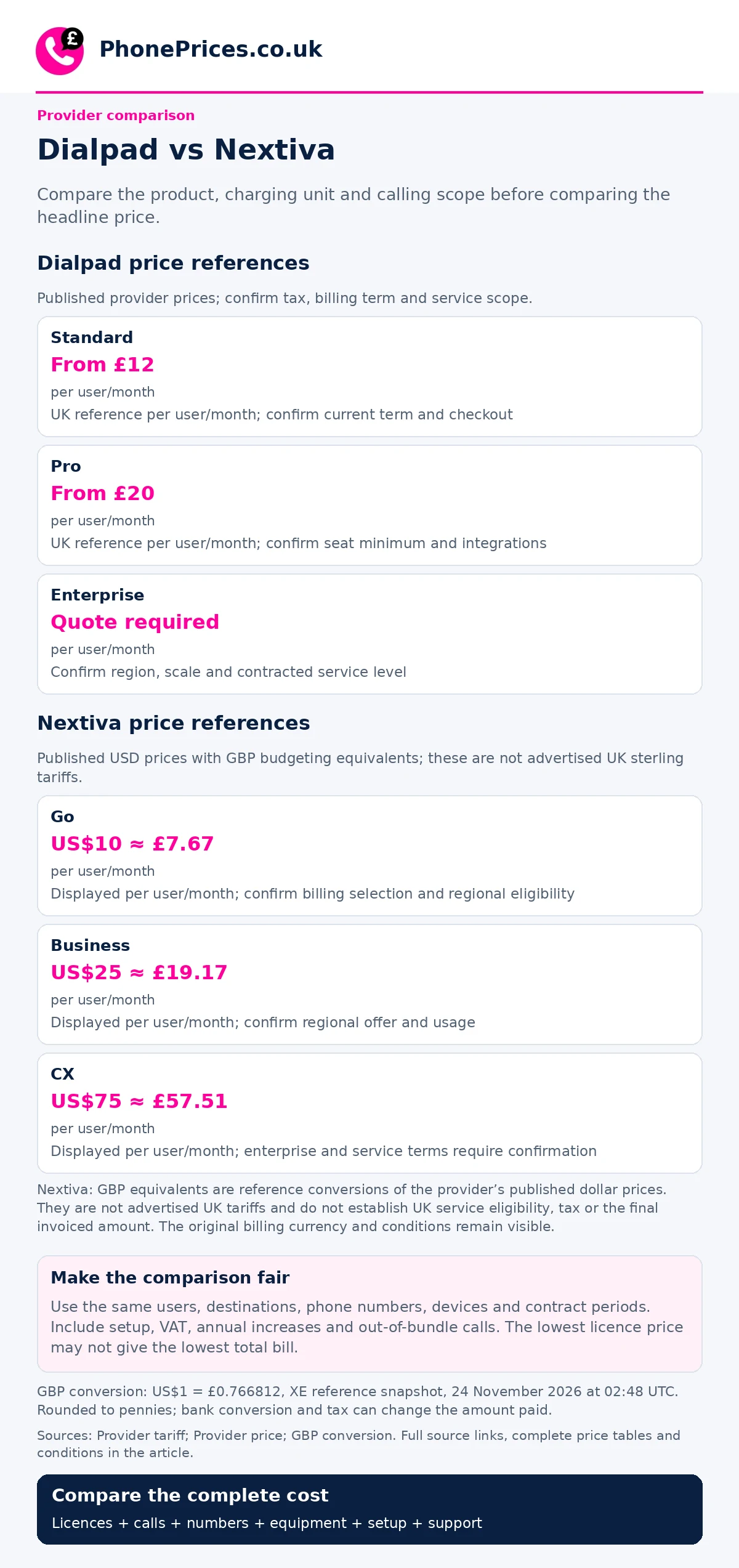
| Dialpad – Standard | From £12 | per user/month | UK reference per user/month; confirm current term and checkout | Provider tariff |
| Dialpad – Pro | From £20 | per user/month | UK reference per user/month; confirm seat minimum and integrations | Provider tariff |
| Dialpad – Enterprise | Quote required | per user/month | Confirm region, scale and contracted service level | Provider tariff |
| Nextiva – Go | US$10 ≈ £7.67 | per user/month | Displayed per user/month; confirm billing selection and regional eligibility | Provider price; GBP conversion |
| Nextiva – Business | US$25 ≈ £19.17 | per user/month | Displayed per user/month; confirm regional offer and usage | Provider price; GBP conversion |
| Nextiva – CX | US$75 ≈ £57.51 | per user/month | Displayed per user/month; enterprise and service terms require confirmation | Provider price; GBP conversion |
Nextiva pricing basis: GBP equivalents are reference conversions of the provider’s published dollar prices. They are not advertised UK tariffs and do not establish UK service eligibility, tax or the final invoiced amount. The original billing currency and conditions remain visible.
Converted figures use US$1 = £0.766812, the XE reference snapshot for 24 November 2026 at 02:48 UTC. Amounts are rounded to pennies. They are budgeting equivalents of the original USD price, not an advertised GBP tariff; tax, bank conversion and regional offers can change the amount payable.
Provider information checked on 24 November 2026: Dialpad UK virtual-number pricing; Dialpad current plan selector; Nextiva current pricing. Prices are a snapshot of the stated public offer, not a personalised quotation. Confirm current eligibility, tax, commitment and inclusions before ordering.
These rows describe different offers, not identical baskets. Keep US-dollar reference figures in dollars; confirm a UK contract rather than inventing a sterling tariff. Compare any eligible base software or collaboration subscription alongside the phone add-on. A quoted system price also needs the same deployment scope before it can be compared with a per-user cloud plan.
What to know about Dialpad
Dialpad Connect is a hosted business calling platform with transcription and other AI-assisted calling tools. Its global price selector can show dollars even on pages visited from the UK, so region and billing frequency matter.
Connect provides calling across supported devices with transcription and summaries. Pro adds more integrations and support options, and Enterprise is quoted. Contact-centre products are a separate purchasing decision.
Buying condition: The UK virtual-number page quotes Standard from £12 and Pro from £20, while the main pricing page may display US dollar rates. Confirm the current UK checkout price, minimum seats, billing term and required integrations.
Read our Dialpad review for its current product and pricing context. In a trial, ask the supplier to reproduce your real call flow and the integration you use most often. That provides more useful evidence than comparing long feature lists without checking the licence required.
What to know about Nextiva
Nextiva’s current public pricing describes Go, Business and CX packages in US dollars. These are reference prices for that advertised offer, rather than verified sterling tariffs for a UK business telephone line.
The current range combines voice and other conversation channels. Business adds more connections and workflow tools; CX adds advanced queues and supervisor functions. Exact telephony coverage and usage are contract-specific.
Buying condition: A UK buyer must obtain written confirmation of UK number supply, number porting, emergency calling, local support and contract eligibility. Do not convert a dollar headline into an advertised UK price.
Read our Nextiva review for its current product and pricing context. In a trial, ask the supplier to reproduce your real call flow and the integration you use most often. That provides more useful evidence than comparing long feature lists without checking the licence required.
Model the bill for your own team
| Reference only | 10 users: monthly base | 10 users: 12 months, unchanged rate |
|---|---|---|
| Dialpad – Standard UK reference, subject to current quote | £120.00 | £1,440.00 |
| Nextiva – Go, displayed US reference price | US$100.00 | US$1,200.00 |
This is illustrative arithmetic from the stated public reference, not a like-for-like savings claim. It excludes tax, equipment, usage, required base subscriptions, installation and increases. Where a supplier needs a quote, leave its total open until the written scope is available. Ten billed users may also differ from ten people sharing a main number.
Which should your business choose?
| If this is your priority | How to use the comparison |
|---|---|
| Dialpad’s typical use case | Request a Dialpad demonstration for teams that value call transcripts, summaries and integration-led workflows. |
| Nextiva’s typical use case | Request a Nextiva demonstration for organisations evaluating customer conversations, automation and a potential international deployment. |
| Lowest complete bill | Match user count, call destinations, term and required features before deciding. |
| Lowest implementation risk | Ask both proposed suppliers for a migration owner, acceptance tests and fallback. |
For a reception or service team, test simultaneous calls, caller waiting, overflow, callbacks and what happens when staff sign out. For sales staff, test the CRM record, caller ID and call logging. For occasional users, check whether the plan can be reduced without losing the main number. These practical differences can matter more than the difference between two headline licence prices.
What to include in each quotation
| Cost or term | What the buyer should establish |
|---|---|
| User licences | Named users, shared phones, reception roles, agent seats and minimum billable users |
| Calling | Included destinations and number types, pooled allowances, overages, forwarding and inbound freephone costs |
| Implementation | Number transfers, call-flow design, installation, user training and weekend work |
| Equipment | Phone ownership or rental, headsets, power supplies, PoE switches and replacement terms |
| Integrations and AI | Required CRM edition, recording, transcripts, storage, usage units and extra licences |
| Contract | Minimum term, annual increases, renewal notice, user reductions and early-exit calculation |
Setup, resilience and number transfers
Before committing to Dialpad or Nextiva, map a real working day: the main number rings reception, unanswered calls move to a group, closed-hours callers hear a different message, and urgent calls have a fallback. Ask the supplier to demonstrate that sequence with the proposed licence. A feature name in a brochure does not show how it behaves when two people answer or the queue is full.
Check broadband, routers, office Wi-Fi and power at each location. A cloud service can be available while an individual office has no connection. Where calls are business-critical, price a suitable backup connection and power protection, and test how users reach the service from a mobile. Check the handling of emergency calls and the registered service address, especially for staff moving between locations.
- Give the new supplier an accurate list of numbers, account details and required call flows.
- Obtain written number-porting acceptance and a migration date before cancelling the old telephone service.
- Test incoming and outgoing calls, caller ID, transfers, voicemail, queues and mobile applications with pilot users.
- Check recording permissions, retention, export and deletion settings before enabling recording or AI processing.
- Keep an escalation contact and a documented fallback during the migration.
For an existing analogue or ISDN installation, include alarms, door-entry equipment, payment terminals and other line-connected devices in the survey. Their compatibility needs checking with the equipment supplier; changing the voice service alone does not prove that every attached device will work.
Additional prices relevant to this comparison
| Product / plan | Specific price | Charging unit | Conditions | Price source |
|---|---|---|---|---|
| Nextiva – AI Super Pack | US$10 ≈ £7.67 | per user/month | Displayed promotional add-on; regular headline US$15; verify eligibility | Provider price; GBP conversion |
| Nextiva – Messaging Super Pack | US$20 ≈ £15.34 | per user/month | Displayed promotional add-on; regular headline US$25; US texting conditions | Provider price; GBP conversion |
| Nextiva – XBert PAYG | US$1.5 ≈ £1.15 | per interaction | After introductory free interactions; separate AI usage | Provider price; GBP conversion |
Price reference summary
| Service | Specific public price reference |
|---|---|
| Dialpad | From £12 |
| Nextiva | US$10 ≈ £7.67 |
Use the detailed tables above for the source, charging unit, eligibility and date. A framework price, a converted USD figure and a retail bundle are different offers; none should be silently substituted for another.
Frequently asked questions
Dialpad suits teams that value call transcripts, summaries and integration-led workflows, while Nextiva suits organisations evaluating customer conversations, automation and a potential international deployment. The better choice depends on the exact licence, UK calling requirements and support proposal. Ask both suppliers to demonstrate the same call flow before deciding.
Only after the offers cover the same requirements. Currency, tax, billing frequency, minimum users, call allowances and underlying licences can differ. Keep a dollar reference in dollars and obtain a UK quote where required. Include setup and ongoing extras before describing one system as cheaper.
A meeting or collaboration subscription does not automatically provide a UK telephone number and calls to ordinary landlines and mobiles. Check whether a separate phone licence, carrier, SIP trunk or calling plan is needed. Ask for the external-calling arrangement to be written into the proposal.
Ask the prospective supplier to check the exact number or number block before committing. Keep the old service active until the transfer has been accepted and coordinated. Identify linked broadband, alarms and other services so that moving a number does not unexpectedly interrupt another part of the business.
Make calls from the office and mobile apps, transfer a caller, leave voicemail and test the closed-hours route. Check a busy queue and the required CRM workflow. Agree who fixes a problem involving broadband, devices or integrations, and document the fallback for a connection or power failure.
Confirm which licence enables recording or AI, the processing and storage arrangements, retention limits and the ability to export or delete material. Test transcription with realistic accents and specialist terms. Set appropriate access permissions and review summaries before using them for customer records or important business decisions.