Pay-as-you-go business calls can cost less when you make few outbound calls. An inclusive or unlimited package becomes attractive as eligible usage rises. The decision depends on the extra monthly subscription you pay to avoid metered charges, the destinations you call and the way minutes are counted.
For example, a £5 subscription with calls at 3p a minute costs £8 at 100 minutes and £20 at 500 minutes. A £15 unlimited alternative sits between those totals. This guide uses published UK provider prices to show where the crossover occurs and which details can change it.
Business call plans: current price examples
Prices checked on 25 November 2026. Figures below exclude VAT. CircleLoop’s pricing gives a straightforward same-provider PAYG comparison; Voipfone’s plan comparison illustrates intermediate minute bundles. Numbers, inclusions and charging rules differ.
| Provider and plan | Monthly subscription | Calling basis | Number allowance |
|---|---|---|---|
| CircleLoop PAYG | £5 per user | Outbound calls from 3p/minute | One UK number per user in the published package |
| CircleLoop Unlimited | £15 per user | Eligible calls included, subject to destination and fair-use rules | One UK number per user |
| Voipfone 100 | £5 per user | 100 included minutes per user | One UK number per account |
| Voipfone 500 | £10 per user | 500 included minutes per user | One UK number per account |
| Voipfone 1000 | £15 per user | 1,000 included minutes per user | One UK number per account |
| Voipfone Unlimited | £20 per user | Eligible usage under the plan conditions | One UK number per account |
At 20% VAT, £5 becomes £6, £10 becomes £12, £15 becomes £18 and £20 becomes £24. A VAT-registered business may be able to recover input VAT under the normal rules, but should still plan for the amount actually paid. Hardware, broadband and extra numbers are separate where not included.
Calculate your PAYG break-even point
Use this calculation when both packages otherwise meet the same requirement: additional monthly subscription ÷ eligible PAYG price per minute. For CircleLoop’s £5 and £15 examples, the difference is £10. Dividing £10 by £0.03 gives 333.33 minutes. At 334 minutes charged entirely at 3p, PAYG reaches £15.02.
| Eligible minutes per user | £5 PAYG plus 3p/minute | £15 unlimited example | Lower subscription-and-call total |
|---|---|---|---|
| 50 | £6.50 | £15.00 | PAYG by £8.50 |
| 100 | £8.00 | £15.00 | PAYG by £7.00 |
| 300 | £14.00 | £15.00 | PAYG by £1.00 |
| 334 | £15.02 | £15.00 | Unlimited by £0.02 |
| 500 | £20.00 | £15.00 | Unlimited by £5.00 |
| 1,000 | £35.00 | £15.00 | Unlimited by £20.00 |
These are ex-VAT calculations using the advertised starting PAYG rate, with every example minute assumed to qualify for that rate and for the unlimited alternative. “From 3p” is not a promise that every destination costs 3p. Recalculate with the actual tariff for your call mix before changing plans.
The same formula works at other metered rates. With a £10 monthly premium, an assumed 5p rate gives a 200-minute crossover and an assumed 10p rate gives 100 minutes. Those two rates are mathematical illustrations, not additional CircleLoop tariffs.
Why a minute bundle can be cheaper than either extreme
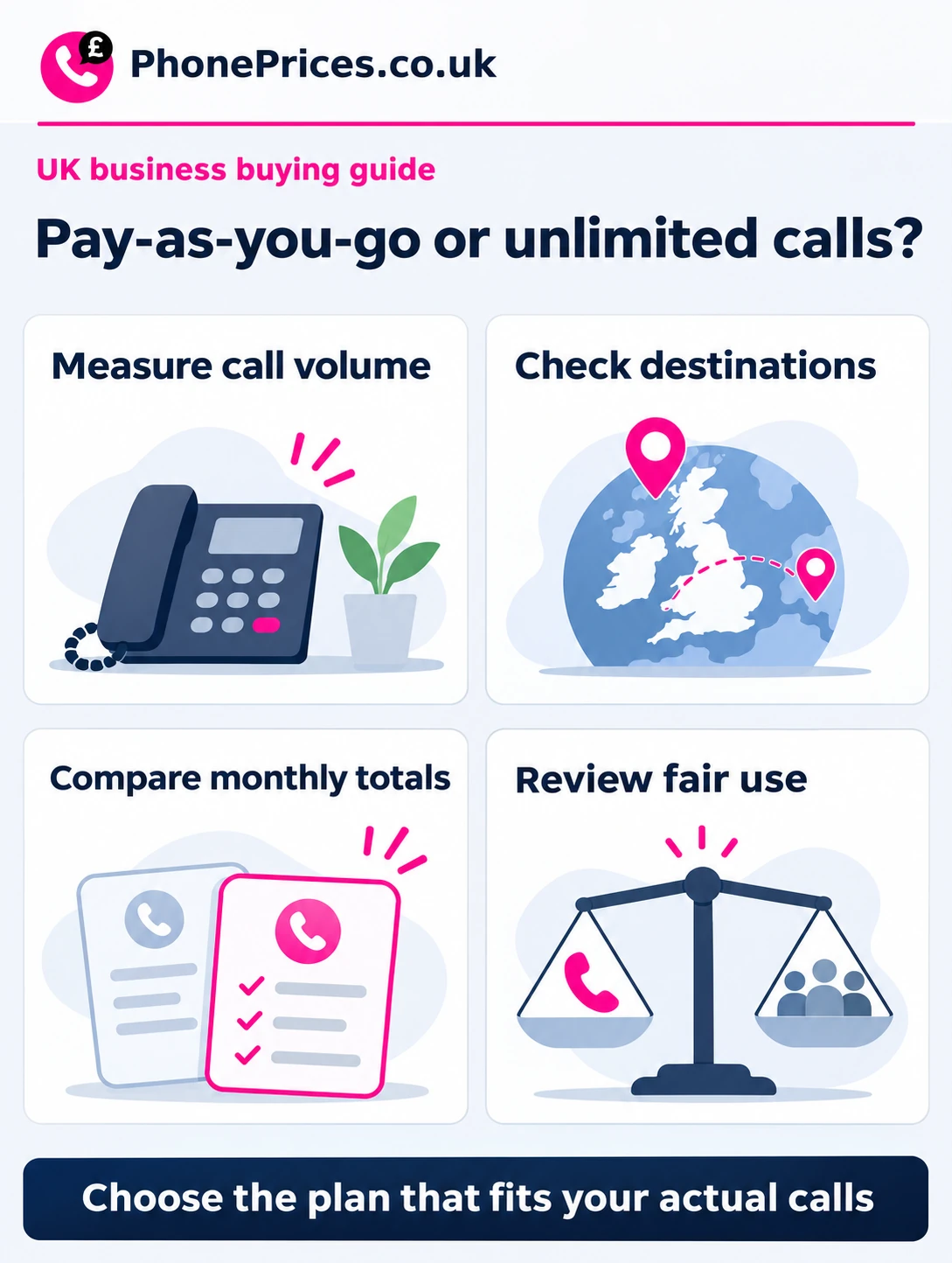
A business making 400 eligible minutes may have no reason to buy an unlimited plan if a lower-priced 500-minute package is available. In Voipfone’s displayed range, that package is £10 per user, compared with £20 for Unlimited. But check the plan’s definition of an included call and how unused allowances are treated.
Voipfone’s billing guidance distinguishes its bundled-minute counting from PAYG billing. Included calls are rounded up to whole minutes; PAYG is charged by the second with monetary rounding and a minimum charge. This can matter more than a small difference in the advertised subscription.
For illustration, 300 calls lasting 20 seconds each contain 100 minutes of conversation. If each call consumes at least one bundled minute, they use 300 allowance minutes. A different 100-minute workload made up of ten 10-minute calls uses only 100 whole minutes. Compare the chargeable units, rather than dividing total seconds by 60 and assuming the result fits the bundle.
Does unlimited include mobile and international calls?
Read the destination list. An inclusive plan can cover standard UK landlines and mobiles while excluding premium-rate services, particular number ranges, international destinations or chargeable forwarding. Included countries may also differ between suppliers and between packages sold by the same supplier.
CircleLoop lists eligible UK and selected overseas destinations in its unlimited offer, including the US, Ireland, Australia, New Zealand and Canada, subject to its conditions. That is not worldwide calling. Check the precise number types and permitted business usage for every destination that accounts for a material share of your bill.
Keep premium and international usage in a separate column of your calculation. If the unlimited plan charges the same extra amount for those calls as PAYG, that usage does not help pay back the higher subscription. A bill dominated by excluded destinations may remain expensive on either package.
Mobile forwarding can change the bill
Answering a business call in an internet app and forwarding it to a mobile telephone number are different operations. The latter creates a call to the mobile network and may be chargeable. A business that rarely dials out can still have substantial billed outbound usage if it diverts incoming enquiries.
For example, take a hypothetical £5 number-and-service subscription with 200 forwarded minutes priced at 7p. Its total is £19 before VAT, despite no staff member making an ordinary outbound call. This is an illustration of the mechanism; use the forwarding rate and inclusion rules on your own quote.
Our virtual landline comparison separates app answering from mobile forwarding. Keep the same distinction when comparing phone-system bundles.
Compare the whole team, not just an average user
| Illustrative four-user team | Minutes each | PAYG at £5 plus 3p/minute | Unlimited at £15 |
|---|---|---|---|
| Two occasional callers | 50 each | £13 combined | £30 combined |
| One regular caller | 300 | £14 | £15 |
| One heavy caller | 1,000 | £35 | £15 |
| Team total | 1,400 combined | £62 | £60 |
All figures exclude VAT and use the same simplified eligible-minute assumptions as above. If the supplier permits mixed packages, the two occasional callers could remain on PAYG, the regular caller could remain on PAYG and the heavy caller could use unlimited, giving £42. Do not assume mixed packages are available: ask whether the account must use one plan throughout.
Also ask whether allowances are pooled across staff. Four separate 500-minute allowances are not always equivalent to one shared 2,000-minute pot. A busy salesperson may incur overage while colleagues leave most of their minutes unused.
What else belongs in the calculation?
- Extra numbers. One number per account and one per user produce different costs for a team needing direct dials. CircleLoop advertises additional numbers from £2 per month excluding VAT; Voipfone lists additional UK numbers at £3.
- Minimum commitments. Compare the full committed cost and notice period, not just one monthly invoice.
- Recording and reporting. A cheaper calling package may require a separate feature subscription for your actual workflow.
- Changes to staff numbers. Check when licence reductions take effect and whether adding someone resets any commitment.
- Overage controls. Establish whether the service warns, stops calls, charges automatically or upgrades the package when usage exceeds an allowance.
A simple process for choosing a package
- Export at least three recent months of calls, including a busy month. Keep duration, destination, user and forwarded-call information.
- Separate eligible calls from exclusions. Convert raw durations to each provider’s actual billing units.
- Add subscription, calls, numbers and required features for each candidate package.
- Check the quiet-month and busy-month totals. Decide how much you value a predictable invoice compared with a lower average cost.
- Confirm the commitment, effective date of changes and any restrictions on mixing user packages.
- Review the first full invoice after switching and repeat the comparison when the team or call pattern changes.
Which option is likely to suit your business?
PAYG deserves a place on the shortlist for inbound-led firms, occasional callers and teams whose outbound minutes are low or irregular. A medium bundle can suit predictable moderate use. Unlimited is more compelling for regular eligible calling where the higher fixed fee is consistently recovered, or where modest extra cost buys useful budget certainty.
The package name should follow the calculation. A £15 plan that includes your actual calls may be good value; the same £15 plan with substantial excluded usage may not be. If flexibility matters, combine this comparison with our guide to business VoIP without a long-term contract.
Frequently asked questions
PAYG can be cheaper when eligible outbound usage is low enough that metered charges remain below the premium for an inclusive package. Use the actual destination rates and billing increments. Include forwarded calls, extra numbers and required features, because these can outweigh the saving in the basic subscription.
Using £5 PAYG, £15 Unlimited and an assumed 3p rate for every eligible minute, the crossover is 333.33 minutes per user per month. At 334 minutes, PAYG totals £15.02 excluding VAT. Different destinations, exclusions or charging rules change that result, so it is an illustration rather than a universal threshold.
No. A provider can round calls to whole minutes when deducting an allowance even where its PAYG tariff uses per-second billing. Numerous short calls can therefore consume a bundle faster than their combined talk time suggests. Check the billing guidance for both plans being compared.
Sometimes, but account rules vary. Mixed packages can save money when one employee makes most of the calls and others use the phone occasionally. Ask whether the provider permits that arrangement, whether allowances are pooled and when individual upgrades or downgrades take effect.
Ordinary incoming calls answered through a standard hosted service may be included, but freephone numbers and mobile forwarding can carry charges. Receiving a call in an app is different from diverting it to a mobile number. Read the charges for the exact number type and answering method.
No package name replaces the destination schedule and fair-use rules. Premium-rate numbers, particular mobile ranges and international destinations may be excluded. Keep those calls separate in your cost model because they can remain chargeable on both the PAYG and unlimited alternatives.
Calculate each person’s eligible usage first, then check whether the supplier allows different packages or pooled minutes. An average across the whole team can hide expensive overage for one heavy caller and unused allowances elsewhere. Include the cost of every required user licence in the comparison.
Review the first full invoice after a change, then reassess when call volumes, destinations or staff numbers change materially. A periodic check using several months of records helps distinguish an unusual busy period from a lasting increase. Also check new contract terms before any renewal.