
Business VoIP with no long-term contract lets you buy an internet-based phone service without committing to several years of subscriptions. It can suit a start-up, a seasonal business or a team whose staffing needs are changing, provided the chosen service also lets you reduce users and move your numbers when needed.
The phrase “no contract” needs care. You still accept service terms, and cancellation can take effect at the end of a billing period rather than immediately. Compare the rental, calling costs, notice deadline and any separate handset or broadband agreement before choosing the lowest advertised monthly price.
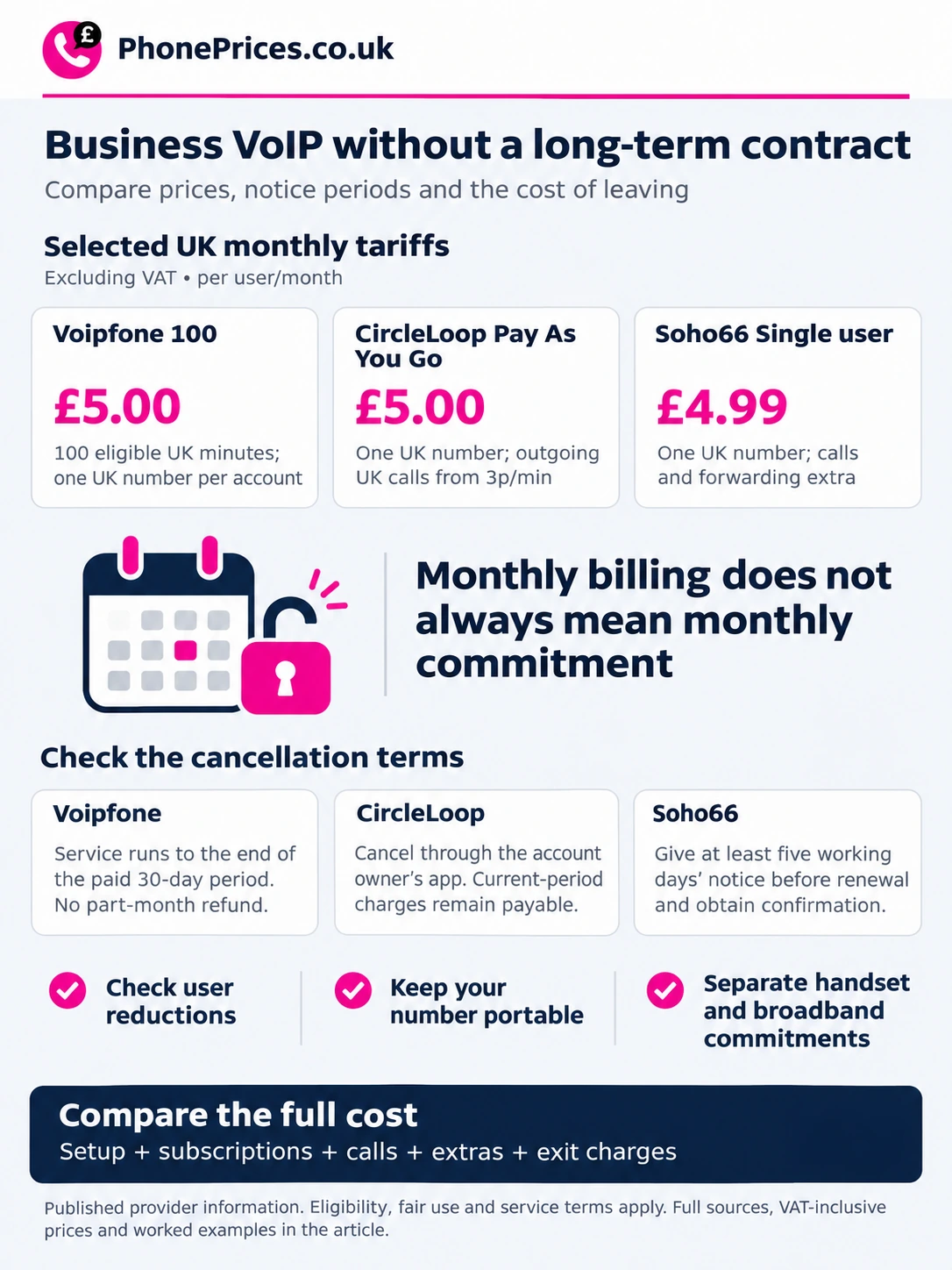
No long-term contract VoIP prices compared
Prices and terms checked on 25 November 2026. The sterling examples below are published business tariffs, with VAT-inclusive equivalents calculated at 20%. These are service subscriptions: existing broadband, devices, additional numbers, chargeable calls and optional features can add to the total.
| Provider and plan | Per user/month ex VAT | Per user/month inc VAT | Calling and number basis |
|---|---|---|---|
| Soho66 – Single user | £4.99 | £5.99 | One UK number; calls and mobile forwarding charged separately unless a suitable call plan applies. |
| CircleLoop – Pay As You Go | £5.00 | £6.00 | One UK national/landline number; UK outgoing calls from 3p/min ex VAT. |
| CircleLoop – Unlimited | £15.00 | £18.00 | One UK national/landline number; eligible inclusive outgoing calls. |
| Voipfone – 100 | £5.00 | £6.00 | 100 eligible UK minutes; one UK 01/02/03 number per account. |
| Voipfone – 500 | £10.00 | £12.00 | 500 eligible UK minutes; one included UK number per account. |
| Voipfone – 1000 | £15.00 | £18.00 | 1,000 eligible UK minutes; one included UK number per account. |
| Voipfone – Unlimited | £20.00 | £24.00 | Eligible unlimited UK calls; one included UK number per account. Usage exclusions apply. |
Price sources: Soho66’s main pricing page and VAT terms; CircleLoop pricing; Voipfone business plans. Confirm the exact plan, order total and current conditions. A service advertised without a long-term commitment may have different terms if bought with a promotion, equipment or another product.
For a broader comparison of systems and features, see our business VoIP providers guide. This article focuses on commitment, cancellation and the cost of changing your mind.
What does no-contract VoIP actually mean?
For this guide, it means a phone service marketed without a long fixed subscription term, typically with monthly renewal or payment. It does not mean that you can stop paying without following the cancellation process, that calls are free, or that every related product can be ended at the same time.
| Description on a quote | What it may mean | Question to ask |
|---|---|---|
| Monthly rolling | Service renews for another period unless cancelled. | What is the notice deadline and final service date? |
| Cancel anytime | You may submit cancellation at any time. | When does billing stop, and is unused time refunded? |
| Paid monthly | The invoice arrives each month. | Is the minimum commitment one month, 12 months or longer? |
| Pay as you go | Calls are metered rather than included in a bundle. | Is there still a recurring licence or number-rental charge? |
| Annual payment | The subscription is prepaid for a year. | Can it be ended early and what money is recoverable? |
| Free or included handsets | Equipment is supplied with the service. | Who owns it, and what is payable or returnable when leaving? |
Ask for the contract summary or order schedule covering the exact package you will purchase. Keep the version you accepted and the written answers to important questions, especially if a salesperson’s explanation differs from the website.
Cancellation terms compared
The following summaries distinguish the ability to request cancellation from the date your financial commitment ends. They apply to the published services described, rather than every possible reseller bundle or individually negotiated agreement.
| Provider | Published cancellation position | What to check when leaving |
|---|---|---|
| Voipfone | Cancel monthly VoIP services through the online control panel. Service continues to the end of the paid 30-day billing period; no part-month refund. | Save confirmation and coordinate number transfers before ending the required service. |
| CircleLoop | The account owner cancels in the web or desktop app. The pricing page says current billing-period charges remain payable. | Confirm the displayed cancellation date and any outstanding usage. |
| Soho66 | Request cancellation at least five working days before the billing date and obtain acceptance. Late requests can incur the next period’s charges. | Check working days, the renewal date and acknowledgement; promotional exceptions may apply. |
| VoIPstudio | Its pricing FAQ says monthly payment, no long-term contracts and no further charge if cancelled before the next billing cycle. | Confirm the renewal cut-off and question any port-out fee against Ofcom’s no-direct-charge rule, explained below. |
Sources: Voipfone cancellation terms; CircleLoop cancellation instructions and its pricing FAQ; Soho66 cancellation policy and minimum-term guidance; VoIPstudio pricing FAQ.
Do not treat cancelling the account and transferring your telephone number as the same task. Arrange a transfer with the receiving provider, confirm when it will complete, and ask the old provider how to stop the remaining services afterwards.
Four providers worth investigating
1. Voipfone: a choice of UK minute bundles
Voipfone’s ready-made business plans provide an ascending choice of calling allowances without a long fixed commitment. Its comparison page says you can change plan monthly. Additional UK numbers cost £3 ex VAT each per month; the included number allowance is per account, so do not assume that each employee receives an extra number.
Its billing guidance also distinguishes bundled minutes from ordinary calling credit. Bundled calls round part minutes up to whole minutes, while unused package minutes do not roll over. A business making many short calls should model that rounding rather than comparing only the total time spent talking.
The same guidance says paying by bank transfer requires at least 12 months’ service payments in advance. Ask about the payment method as well as the minimum service term if preserving cash is important. Our Voipfone review covers the wider product.
2. CircleLoop: apps with PAYG or inclusive calling
CircleLoop offers a choice between paying for outgoing calls and paying more for eligible inclusive calling. Its pricing page lists no setup fee, free number porting subject to eligibility, call recording and voicemail-to-text. Check whether its supported mobile and desktop apps fit how staff work.
Its quick-start guide says subscriptions can be upgraded or downgraded once per billing cycle. That is useful context when comparing the ability to change a tariff with the separate ability to remove staff licences. Ask when a user reduction takes effect and whether any minimum paid quantity applies. See our CircleLoop review.
3. Soho66: low rental with usage priced separately
Soho66’s Single user package can be worth considering for a small operation wanting a UK number and a compatible phone or app. Do not price a multi-user team by assuming that several copies of the single-user package give the same features as its separate team product.
Its call-plan page lists PAYG UK landline rates of 1p/min peak and 0.5p/min off-peak, with standard mobile rates of 8.5p and 8p/min respectively, excluding VAT under its terms. Optional call plans are additional account-level charges; confirm which calls and forwards they cover.
The minimum-term guidance also warns that a promotion can introduce a minimum period. Check the offer you actually accept and follow the cancellation notice rule above. Read our Soho66 review for more detail.
4. VoIPstudio: another monthly option, with currency checks
VoIPstudio’s public pricing page displays US-dollar prices in the version checked. These are not sterling tariffs, so they are separated from the UK-pound table. Ask for the currency and tax treatment on your actual order.
| VoIPstudio option | Published monthly amount | Basis and additional costs |
|---|---|---|
| Pay as you go | US$6 per user | Outgoing calls and paid numbers are additional. |
| 2K Bundle | US$20 per user | One inbound number and 2,000 minutes per user; destination and number eligibility apply. |
| CX add-on | US$14 per user | Optional supplement to a core plan; not a standalone phone subscription. |
Its pricing page advertises no long-term contracts. Check the complete number cost, calling destinations, cancellation date and any card conversion fees before comparing it with a GBP bill. Our VoIPstudio review explains the broader service.
Question published port-out fees: VoIPstudio’s terms list £15 per individual number, £8 per number in a 10-number range and £3 per number in a 100-number range. However, Ofcom’s business guidance says customers must not be directly charged for number porting under C7.6(c). Ask the provider to explain and reconcile any proposed charge with that rule; do not assume a listed port-out fee is payable. Separately, check remaining subscription, equipment and support commitments.
When is a monthly rolling service good value?
Flexibility has a practical value when you might need fewer users, change software or stop trading from a location. A fixed deal can still be worthwhile if it gives a lower complete cost over a period you are confident you will use. Compare both the expected cost and the amount remaining payable if your plans change.
- A new business: call volumes and staffing may be uncertain, making a small initial commitment useful.
- Seasonal staffing: temporary users can become expensive if you must keep paying for them after a busy period.
- A short project or office: check that both the phone service and connectivity can end on the required timetable.
- A system trial: monthly service can support a longer operational test before making wider commitments.
- A stable team: an annual or longer offer may save money if all users, features and support are genuinely comparable.
Flexibility is only useful if the product can do the work. Check queues, transfers, business hours, recording, integrations and support before using contract length as the deciding factor. A cheap plan that forces staff into manual workarounds can be poor value.
Worked costs for different team sizes
The calculations below illustrate published subscription rates and explicitly stated assumptions. They are not personalised quotations or market averages. All sterling totals exclude VAT unless shown otherwise, and assume no extra hardware, installation or chargeable add-ons.
Example 1: five users with moderate eligible UK calling
Using Voipfone 500 at £10 ex VAT per user/month, five users have a baseline subscription of £50 ex VAT/month, or £60 inc VAT. Keeping that configuration for a year gives £600 ex VAT. This assumes each user’s calls fit the selected allowance and excludes extra numbers, diversions and optional services.
Example 2: paying only for the users you need
Consider a hypothetical rolling quote at £15 per user/month, with ten users required for four months and only four users for the next eight months. If reductions are permitted from the next period with no minimum quantity, the subscription calculation is:
| Staffing period | Calculation | Ex-VAT total |
|---|---|---|
| First four months | 10 users × £15 × 4 months | £600 |
| Next eight months | 4 users × £15 × 8 months | £480 |
| Rolling total for the year | £600 + £480 | £1,080 |
| Ten licences retained all year | 10 × £15 × 12 months | £1,800 |
| Potential difference | £1,800 − £1,080 | £720 |
The £15 rate is an illustrative input; this is not a claim that a particular provider permits that reduction. Put the same staffing pattern into each supplier’s written rules. Check whether reducing licences also removes numbers, recordings, queue access or other features you still need.
Example 3: a lower fixed rate can cost more for short use
Suppose a business needs five users for six months. An illustrative rolling offer is £15/user/month with no setup fee. A different illustrative offer is £12/user/month with a 24-month minimum and a £150 setup fee.
| Hypothetical option | Subscription calculation | Total ex VAT |
|---|---|---|
| Rolling service used for six months | 5 × £15 × 6 | £450 |
| Fixed service over its minimum term | 5 × £12 × 24 + £150 | £1,590 |
| Difference in scheduled commitment | £1,590 − £450 | £1,140 |
These are assumed offers used to show the effect of commitment, not live supplier prices or an early termination quote. The fixed arrangement could be competitive for a business using it for the full period; its early exit charge would depend on the agreement.
What can make a flexible service expensive?
A low licence price can be outweighed by a calling pattern that does not suit the plan. Use a recent itemised bill or a realistic estimate of destinations, number of calls and duration. Include calls forwarded to mobiles, not just those made by staff.
- Numbers: check whether rental is per user, per number or per account, and how much direct-dial numbers add.
- Calls: compare included destinations, fair use, minimum call charges and rounding.
- Features: add recording storage, CRM connectors, reporting and receptionist tools where necessary.
- Setup: request porting, configuration, training and installation as separate line items.
- Support: identify who helps when the service stops working and whether that support has a separate commitment.
- Payment: compare prepayment, automatic credit top-ups, tax and the billing currency.
- Leaving: ask about port-out fees, prepaid balances, data export and equipment returns.
For a complete office budget, our phone system prices guide covers equipment and setup alongside subscriptions. If you only need a business number on an existing mobile, compare virtual landline services as well.
Check handsets, broadband and reseller agreements separately
A phone subscription may be flexible while the equipment or connectivity is committed for much longer. Read each order line rather than accepting a single description for the entire purchase. If buying through a reseller, use that reseller’s agreement for price, support and exit terms.
| Component | What to establish before ordering |
|---|---|
| VoIP subscription | Minimum term, billing cycle, notice and ability to remove users. |
| Handsets and headsets | Purchase, rental or finance; ownership, compatibility, return conditions and remaining payments. |
| Broadband or leased line | Its own minimum term, installation arrangements and cancellation costs. |
| Managed support | Whether support or maintenance continues after the phone subscription ends. |
| Numbers | Portability, release process, charges and any dependencies between the main number and other services. |
| Software and integrations | Who controls the accounts and whether licences are bought separately. |
Ask for the equipment model and approved firmware before buying handsets elsewhere. If you expect to change providers, request confirmation that your purchased devices can be reused and that you will have the credentials or provisioning support needed. Our office phone buying guide explains the hardware choices.
Free trials: useful, but check how payment starts
A trial is best used to test the working service: audio in your office, mobile background ringing, transfers, caller ID, queue behaviour and administration. Use a temporary number until the essentials are proven, then plan any business-number transfer.
CircleLoop’s quick-start guide describes a seven-day trial without a card, limited to ten inbound and 30 outbound calls. Adding payment details starts a subscription charge on day seven; without them the trial account closes. VoIPstudio’s pricing FAQ instead says its 30-day trial requires a valid card. Keep the renewal date visible and confirm which features are restricted.
Do not use a trial label as evidence that all setup, hardware or migration work can be refunded. Ask what happens to test numbers, recordings and paid extras, and save the cancellation acknowledgement if the trial is unsuitable.
How to switch without losing your number
- Review the current account. Collect your provider, account name, billing details, numbers and renewal dates.
- Get a written exit position. Ask for the required notice and any remaining payments for each service.
- Test the receiving service. Confirm the essential features, devices and connections before a live transfer.
- Request porting through the new provider. Check number eligibility, dependencies, fees and the proposed transfer date.
- Keep the old number service active. Coordinate cancellation with the transfer rather than disconnecting it first.
- Save essential data. Export recordings, voicemail and call records you need before access ends.
- Test incoming and outgoing calls after transfer. Confirm caller ID, routing, voicemail and the fallback destination.
- Close remaining subscriptions deliberately. Obtain confirmation and review the final bill for numbers, users and add-ons left behind.
Avoid assuming that moving the number automatically ends every charge on the account. Equally, ask what a transfer will do to services linked to the old line. For the wider migration context, see our business phone lines guide.
Questions to put to each shortlisted supplier
- What is the shortest service commitment for this exact quote?
- What date does cancellation have to arrive, and when will billing stop?
- Can I remove users monthly, and is there a minimum paid user quantity?
- Does an upgrade, replacement handset or promotion restart a minimum term?
- Which number, setup and forwarding charges are outside the headline price?
- What equipment, broadband or support commitments remain if I leave?
- How do I transfer numbers out and download the data I need?
- Who is responsible for resolving faults, including problems with connectivity?
Ask suppliers to quote the same users, destinations and features, then compare three totals: the first month, a typical full year and a shorter period reflecting your realistic chance of leaving. This makes contract flexibility part of the cost calculation.
How we selected these options
We selected four providers whose public information explicitly describes monthly payment, cancellation or the absence of a long-term phone-service commitment, and which publish relevant prices. Sources are the providers’ own tariffs, support pages and terms, checked on 25 November 2026. No comparison website is used as a price source.
This is desk research rather than hands-on testing or a universal ranking. UK-pound prices and US-dollar references are kept separate. Worked totals identify their assumptions, and the hypothetical staffing and fixed-term examples are not presented as supplier quotations. Always check the signed order where it differs from public marketing.
Choosing a flexible business phone service
Start with the functions and call volumes your business needs, then compare the service commitment and the amount you would still owe if staffing changed. A monthly option can be attractive when uncertainty is high; a longer agreement needs enough practical value to justify the commitment.
Shortlist two or three services, test them with representative users and obtain written answers on cancellation and licence reductions. The right choice combines an affordable complete bill with an exit process your business can actually use.
Frequently asked questions
It can still have a paid billing period, a cancellation deadline or a promotional commitment. “No contract” generally describes the absence of a long fixed term, rather than an absence of service terms. Check the exact order, including any separate equipment, broadband and support agreements.
No. A supplier can invoice monthly while requiring a 12-month or longer commitment. Monthly rolling normally means renewal for another short period unless cancelled under the applicable terms. Ask for both the minimum service term and the notice period, and keep the written answer with your order.
You may be able to request cancellation then, but service and billing can continue until the paid period ends. Voipfone’s published monthly VoIP terms expressly exclude part-month refunds. Other providers use their own deadlines and policies, so check the final service date before assuming a refund is due.
Adding users and reducing paid licences may follow different rules. Confirm when reductions take effect, whether a minimum paid quantity applies and whether removing someone affects numbers, recordings or shared features. A monthly account does not automatically guarantee that every licence can be removed immediately.
Arrange a transfer with the new provider before ending the existing number service. Confirm that the number can move, agree the cutover plan and check any fees. Do not assume that cancelling the old account initiates a transfer or that porting automatically ends every subscription.
The comparison primarily covers service subscriptions. A handset may be bought separately, rented or supplied under its own payment agreement. Ask who owns each device, whether it must be returned and what remains payable when the VoIP subscription ends. Existing compatible apps or equipment may avoid a new purchase.
They can suit lighter outgoing use, but a recurring licence or number charge may still apply. Frequent calls, mobile forwarding and chargeable destinations can make an inclusive plan better value. Compare a typical itemised month, including call rounding and exclusions, rather than choosing solely by the rental.
Many internet-based phone services can be used over a suitable existing connection, but confirm the provider’s requirements and support boundaries. Test your network and devices before transferring numbers. Ask separately about resilience and emergency calling, since a flexible phone subscription does not prevent broadband or power failures.
Some do and some do not. The providers in this guide describe different trial arrangements, including different card requirements and renewal behaviour. Check the trial end date, usage limits and cancellation process before starting, and retain confirmation if you decide against continuing with a paid subscription.
Compare the full monthly bill, minimum term, cancellation notice, user-reduction rules and number-transfer process. Add equipment, setup, broadband and support costs where relevant. Check the exact plan’s calling allowances and essential features, then test representative calls and workflows before making the business dependent on the service.